

(Text updated April 1, 2026)
If
a comic-book character’s popularity can be measured by how many issues they
appear in during a given month, then Jonah Hex hit one of the highest points in
his career in the midst of “The DC Explosion”.
During a two-month period, he was featured in not only his self-titled
book, but one of DC’s flagship titles and his very own one-shot special. Taken singly, each of these stories is an odd
little side-trip away from his usual stomping grounds, and seeing them
altogether on the newsstand must have presented a bizarre picture to any new
reader discovering Hex for the first time.
Atypical stories or no, each of them would prove to be life-altering for
our favorite bounty hunter on one level or another.
We’ll
start off with Jonah Hex #17 (October 1978), drawn by Vicente Alcazar. Jonah’s been lured to Charleston by a promise
to $5,000, though when he gets there, he discovers that the money is to be
payment for flying a hot-air balloon to Europe.
The inventor wishes to remain on the ground in order to drum up the proper
press, and knows Jonah’s the sort of man who will do anything for the right
price. In this case, though, five
thousand bucks ain’t it, so he refuses, which doesn’t stop the inventor from
bashing Jonah on the head and forcing him into the balloon’s gondola. He comes to as the balloon lifts off and
manages to grab the inventor, but that action doesn’t turn out as planned, with
the inventor plummeting to his death soon after.

Adrift
in a balloon with no experience in how to control it, Jonah spends the next
three days at the mercy of the winds, which carry him out over the Atlantic
Ocean and all the way down to the coast of South America. When he’s finally spotted by a ship, it
blasts him out of the sky and takes him captive -- turns out this is a slave
ship bound for Brazil, and they think he’s going to rat them out (slavery was
on the decline in Brazil during the 1870s, but it wasn’t officially abolished
until 1888). After being thrown in with
the “cargo”, Hex finds that the enslaved Africans were working on an uprising, led
by their king, Mbwasi, who luckily for Hex speaks English. Also in the hold is Cricket, a Black man
tossed down there after disobeying the captain.
Unfortunately, when they break out of the hold and make their way up to
the main deck, they discover Cricket was actually put down there as a spy, for
he goes running to the captain the first chance he gets (also, just like with
WWT#29, the Comics Code Authority lets the word “darkies” make it into print). In the midst of a terrible storm, both sides
fight it out, and the Africans eventually take over the ship, wiping out the
crew in the process, along with Cricket and Mbwasi.
With
no one left to control the ship, it soon crashes against the Tortuga shoals
(though exactly which Tortuga shoals
those would be is unknown, as many places in South America are known by that
name and none appear to be located off the coast of Brazil). Hex and a handful of Africans survive the
wreck, and are soon rescued by a tribe of Blacks in canoes. Now, this isn’t the happy ending it sounds
like: At the beginning of the tale, Jonah overheard the slavers talking about a
tribe of cannibals that lived on an island in the area, and when Hex sees their
blue-painted faces, he realizes that’s who picked them up! Jonah tries to warn the Africans, but since none
of the survivors speak English, it’s no use -- the only good thing is that the
Africans talk the cannibals into letting Hex go since he helped them
escape. Jonah is given a small canoe,
and as he paddles away, we’re left to wonder if the Africans will end up on the
menu.
Jonah’s
Brazilian adventure continued in JH#18, which featured Val Mayerik and Danny
Bulandi on art. Now paddling his canoe
up the Amazon, Jonah comes across a group of men torturing a native boy, so he
jumps the guys and guns them down with their own pistols (Jonah lost his when
the ship went down). As he frees the
boy, another native hiding in the trees zaps Jonah with a poison dart (that’s
gratitude for ya), but he manages to stumble back to his canoe and escape
before passing out. Sometime later, he
gets dumped into the water after his canoe tumbles over a waterfall, and his unconscious
body washes up on the outskirts of a rubber plantation. When Jonah recovers, he finds himself in the
company of siblings Paul and Vanessa Venal, who own the plantation. Hex is rather surprised that they know his
name, and any sharp-eyed reader should be surprised as well: They claim to know
it because his name was written on the sweatband of his hat, which was
recovered along with all his other possessions when they found him...but Jonah
lost all that stuff when the slave ship was destroyed! Fleisher must’ve hoped the readers wouldn’t
notice this continuity error, and would simply be happy to see Jonah in his
Confederate duds again.
Of
course, there’s still the matter of him being unarmed, but Paul soon remedies
that by lending the bounty hunter some guns from his own collection, which
leads to the introduction of something that would come to be considered part of
the “classic” Jonah Hex look: A matched pair of ivory-handled Colt Dragoons. Though there are errors in both the text and
the art this first time out, it’s specified in the letter column of Jonah Hex #31 that these guns are meant
to be Whitneyville-Hartford .44-caliber Dragoon pistols, manufactured by Colt
Firearms back in 1848, with a limited run of only 240 (a few dozen are known to still
exist). It’s not only a rare handgun,
but deadly as well, with a firing power that wasn’t surpassed until the
invention of the .357 Magnum in the 1930s, so you know Jonah didn’t just pluck
those things off the wall at random.

Not
long after, Paul convinces Hex to help rescue some workers who were kidnapped
by the local tribe, the Kre-Ena-Krore, though the reality is the Venals want
the natives wiped out so they can acquire their legendary treasure. What follows is a textbook lesson in the
dangers that lurk within the jungle, like boa constrictors, quicksand, and
bow-wielding natives who’d rather you not wipe them out. Jonah eventually learns about the true
purpose of his mission, as well as what this “treasure” really is: A hut full
of shrunken heads! Don’t worry, the
Venals get what’s coming to them in the end, and Jonah rides off with those
ivory-handled Dragoons still on his hips.
We can presume that the bounty hunter must’ve hightailed it for the
nearest seaport and the first ship heading to the States, as he’s back home
safe and sound by the next issue.
Looking back, it’s strange that Fleisher would go to all the trouble of
inventing a way to get Hex down to South America, then only do two stories
there. It’s a bit of a letdown that we
didn’t get more.
At
the same time Jonah was wandering around Brazil, he also turned up in Justice League of America #159-160, marking
his first guest appearance in someone else’s book...and if you’re one of those
fans who likes to imagine that Jonah Hex exists in a universe separate from the
DCU, please skip the next few paragraphs, because what follows here might make
your brain explode. This tale, written
by Gerry Conway -- who’d also taken over penning Scalphunter’s adventures a few
months earlier with Weird Western Tales #45
-- and drawn by Dick Dillin & Frank McLaughlin, starts at the annual
JLA/JSA shindig. After four pages of
idle superhero chatter, we get an explosion, followed by three pages of the
Lord of Time, the villain of our piece, telling us one of the most ridiculous
setups you will ever read in a comic book.
Apparently, he’s created an ultimate supercomputer and programmed it to
stop all of time, but after activating it, he realized that’s a very bad idea,
and he can’t stop it from carrying out the program. Only the combined might of the JLA and JSA
can defeat the computer, but since he’s the villain, the Lord of Time can’t
just ask for help, so he instead plucks five legendary warriors out of the
timestream and has them literally crash the superheroes’ party, therefore
tricking the superheroes into
attacking the Lord of Time’s stronghold and destroying the supercomputer...and that, my friends, is the explanation for
why Jonah Hex, the Black Pirate, Enemy Ace, the Viking Prince, and Miss Liberty
are appearing in a JLA book.

After
blowing the place to Hell and gone (and rendering a bunch of the superheroes
unconscious in the process), Jonah and his new friends step back to reassess
the situation, as none of them are aware of why they did it. There’s some muttering about being compelled
by an unknown voice, and overall, our time-tossed quintet is rather shaken by
all of it...except for Jonah. “Seems
somebody, somewhere, up and yanked us away from our own business, with all the
good manners of a slimy carpetbagger!” he declares, reloading his gun. “I figger we owe that somebody for the
inconvenience!” If you believe in
retcons, there’s a possible explanation for why Jonah is taking all this
craziness better than the rest, and we’ll discuss it much further down the line
in Chapter 12. In the meantime, let’s focus on the fact
that, as the issue progresses, these five
people kick the collective asses of the JLA and JSA. Okay, they did have augmented weapons
supplied by the Lord of Time, and Jonah even gets a flying horse, but still,
we’re talking five against twenty here (going by a head-count of who’s on the
first page). How insane is this?
Not
as insane as the next issue, which would later be one of many DC issues
reprinted by Whitman Publishing (but not the previous issue for some reason),
which means JLA#160 was likely the first introduction to Jonah Hex for many
young’uns in the late 1970s and early 1980s whose parents grabbed a Whitman
polybagged pack of comics at grocery and drug stores across the United
States. And boy o boy, what an intro! After the Lord of Time literally puts them on
display right outside his stronghold in the year 3786 in order to lure the
superheroes there, our five warriors decide they’re not gonna take this abuse
much longer and storm the place themselves (I like to think that Jonah goaded
the other four into it). Once inside,
they come face-to-face with both a Tyrannosaurus Rex (or “a toad-frog outta
Hell”, as Jonah calls it) and a passel of lizard-men, all of which do what the
superheroes couldn’t last issue, namely knock these five people flat, thus
putting an end to Jonah’s direct involvement in this tale. We do see a comatose Hex near the end, and
there’s a throwaway line on the last page about how the League, after they
defeated the supercomputer, returned the five warriors to their respective
times, but other than that, those in search of cowpoke action need not concern themselves
with the rest of this story.
As crazy as it all was, though, these two JLA issues set a bit of a precedent
for ol’ Jonah, and within seven years, his involvement with both time-travel
shenanigans and the long-underwear crowd would become part of his main
storyline, as opposed to something special trotted out for guest-spots that
could easily be ignored. Love it or hate
it, the notion of Hex comfortably mingling with superheroes across time and
space starts here.

Another
notable thing to be found in JLA#160 is an advertisement -- which also appeared
in JH#18 -- for a new offering in DC’s Dollar Comics line. Technically titled DC Special Series #16 but more commonly referred to as the Jonah Hex Spectacular (Fall 1978), this
ad-free special boasted not only a 30-page Hex story, but two 17-page backups
featuring Bat Lash and Scalphunter, plus an action-packed Jose Luis
Garcia-Lopez cover and a black-and-white mini-poster by Luis Dominguez, making it
one heck of a deal for just a dollar. It’s
the plot of the main story, however, that makes the Spectacular an unforgettable landmark in Jonah’s history.
“Well,
the first idea I had was to do a story about Jonah Hex being old,” Michael
Fleisher said in The Comics Journal
#56 (May 1980). “I've been trying to get
DC to let me do a whole separate series about Jonah Hex as an old man. I'm not having any luck. But that was my idea to do a story about
Jonah Hex in his 60s...and I knew that I'd already established, at least in my
own mind, that Jonah Hex was born in 1838.
So I said, ‘Gee, 60s, what year would that be?’ and I found myself in
the early 1900s.”
And
that’s also where the reader finds themselves as “The Last Bounty Hunter” opens in 1904, with a white-haired Hex still
tracking down outlaws at the ripe old age of sixty-six. The march of time has changed him a little --
instead of the aimless wanderer he was in the 1870s, he’s settled down in
Cheyenne, Wyoming with a young Comanche gal named Tall Bird, and has to wear
reading glasses when filling out reward vouchers -- but otherwise Jonah’s just
as ornery and dangerous as always.
Unfortunately, the rest of the world is rapidly leaving him behind, a
fact pointed out to him by Michael Wheeler, an American History professor from
Princeton who wants to write a book about Jonah. The idea that anybody would want to do such a
thing intrigues the bounty hunter just enough for him to let the man stick
around.
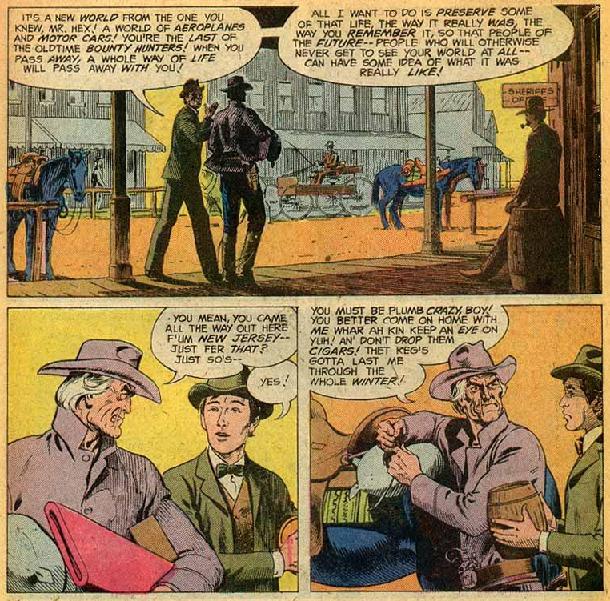
Wheeler
spends months with Hex and Tall Bird, taking down all the details of the bounty
hunter’s long life. One afternoon, when
the two men are out hunting, they encounter Lew Farnham, who runs a traveling
Wild West show. Seems he wants Hex to
hire on with him so he can turn the old man into a cross between Buffalo Bill
and a rodeo clown, complete with a white spangled outfit that bears Jonah’s
name “emblazoned across the back in genuine simulated rhinestone
diamonds!” Not surprisingly, Hex turns
Farnham down flat, walking away from the man with a grim look in his eyes.
Many
days later, Hex and Wheeler return to the homestead and discover that Tall Bird
has ben kidnapped by outlaw George Barrow, who lost four of his men to Hex at
the beginning of the tale. Wheeler bravely
assists Jonah in rescuing her, but Barrow manages to escape. Hex dismisses his wife’s worries about his
own safety and sends her home, while Wheeler accompanies him to Cheyenne to
collect the bounties on the remainder of Barrow’s men. It’s morning by the time they arrive in town,
and as they leave the sheriff’s office with the money, Wheeler excitedly points
out a new-fangled 3-horsepower Oldsmobile parked out front (Fleisher and artist
Russ Heath had a discussion about what type of automobile to use, and Fleisher
said they went with a period-accurate one despite it looking “a little dumpy”
compared to, say, a Ford Model T from 1911).
Having
no interest in “them noisy contraptions”, Jonah instead sits in on a poker game
at a saloon while waiting for Wheeler to get back from a joyride with the
Oldsmobile’s owner. The bounty hunter
soon finds that he’s having a hard time focusing on the cards, so he removes
his glasses to clean them off, just as George Barrow, eager for revenge, bursts
in with a shotgun. Caught off-guard,
Jonah barely has time to draw his pistol when Barrow’s on him, bashing him in the
face with the butt of the shotgun, then letting Hex have it with both
barrels. Wheeler returns in time to see
the local law take out Barrow, but it’s too late for Jonah, who passes away in
Wheeler’s arms after gasping out his final words: “It’s cold...”

Not a hoax, not a dream, not an imaginary story: Jonah
Hex was shot dead by George Barrow in the Winter of 1904. And as the reader is still trying to come to
terms with this cold hard fact, the blows keep on a-comin’. While Wheeler and Tall Bird are preparing a
funeral pyre for Jonah’s body, Lew Farnham and his assistant show up to steal
it. Wheeler is shot in the struggle,
Tall Bird knocked unconscious, and the cabin set ablaze to cover up the
crime. Farnham then takes the body to a
taxidermist to have Jonah stuffed, mounted, and dressed in that godawful
costume Farnham made for him. Despite
the indignities, Jonah does manage a spot of revenge from beyond the grave: As
Farnham’s assistant tries to wedge Jonah’s gun into his hand, it goes off in
the guy’s face (Farnham blames it on the gun’s hair-trigger, but doubt will be
thrown on this assessment many years later).
As time passes, Jonah’s corpse is
displayed in one town after the next, making oodles of cash for Farnham, who
eventually gets his at the hands of a gang of robbers. Then comes the final insult to Jonah’s
afterlife, as the robbers take his body and sell it to an antique dealer, thus
setting off decades of Jonah Hex being passed from one owner to the next, until
it’s completely forgotten that he’s actually a preserved corpse and not some
ugly statue (it’s very likely that Fleisher was inspired by the strange case of
Elmer McCurdy, a train robber whose embalmed body was put on display starting
in 1911 and eventually misplaced for decades before its rediscovery in December
1976, barely two years before “the Last Bounty Hunter” was published). The final panel shows his body on display at
an amusement park, looking rather pathetic as he stands in the rain, alone and
forgotten.

“It made me very unhappy, that story,”
Fleisher said in his TCJ interview. “It
made me very sad and upset. The people
who think that story is some sort of a sadistic toying with the reader are
really wrong because I got very choked up writing that story, because it was
the death of a character that I really loved -- not only loved, but I feel is
really me.” It also may have never been
published if Larry Hama -- editor for both this and Jonah’s regular title at
the time -- hadn’t supported it. Keep in
mind that not only does this story kill off a major character (not unheard of
at the time, but still unusual), but one that will still be appearing in a monthly title once this story is over
with. Fleisher dared to tell the readers
how the saga of Hex’s life was going to end long before that saga was even
close to wrapping up. The fact that,
technically, every Jonah Hex story is a flashback makes such a thing possible
(remember, this is a Western character living well over a century in the past),
but there were some in the comics industry who felt this particular revelation
would dull the sense of danger in subsequent Hex stories, since the readers now
knew how he was really going to
die. In response, Fleisher pointed out
that people had no trouble reading Superboy stories when they knew good and
well he was going to grow up to be Superman.
Fleisher
also related how many people at both DC and Marvel (for whom he also did
freelance work) were praising him for it.
“I saw when I was at Marvel a few weeks ago, a British fan magazine,
whose readers had selected ‘The Last Bounty Hunter’ as the best story of the
year, tied with Superman Vs. Muhammad
Ali.” Unfortunately, I’m uncertain
as to which publication Fleisher is referring to here: I did look up the UK’s
Eagle Awards for that year in case that’s what he was referencing, and did find
nominations for both Jonah Hex (for
Favourite Comic Magazine) and Superman
Vs. Muhammad Ali (for Favourite Single Story), but they didn’t appear in
the same category together…and for the record, both titles lost in their
respective categories to the X-Men. However,
I can confirm that the story was “honored” with a three-page parody in The Buyer’s Guide for Comic Fandom #257
(October 20, 1978) by writer/artist Eddie Eddings. Titled “The Death of Jonah Hoax”, a cartoony
version of our favorite bounty hunter spins tall tales for the fella writing
down his life story (to be clear, Jonah was never a merman, nor did he work as
a lion tamer or take a cruise to Tahiti...though the supposed fib that he’d met
aliens would turn out to be true much later in Hex history!). Overall, it’s on caliber with what John
Albano & Tony DeZuniga delivered in their Zany parody a few years prior.

The reception wasn’t all praise and
playful jabs, however, as Fleisher went on to say that “there were people who
felt angry” in regards to him daring to kill off Hex in such a manner. “‘How dare
he write about a death that's not valiant? Jonah Hex could die, but at least he
should die saving a whole city,’” Fleisher said, summarizing the small number
of negative letters received for the story, followed by him stating that he
didn’t think a person like Jonah Hex would die in a heroic fashion, even if
some folks felt that Jonah’s fate in “The Last Bounty Hunter” was
pointless. “You live by the sword, and
you die by the sword,” he said plainly, later comparing what happened to Hex to
the death of Wild Bill Hickok, who was murdered in 1876 when, in a rare lapse of
judgement, he sat with his back to the door of the No. 10 Saloon in Deadwood, allowing
Jack McCall to sneak up and shoot him unawares.
“And if you have a psychological bent, you have to say, ‘Why on this
occasion did this person do something -- a person who’s at home in this violent
milieu -- why did he do that?’ Well,
part of him must have thought it was over, and he wanted to go. And I thought that, to me, it was right that
that would happen.” Such thinking
follows a rule Fleisher said he adhered to in his writing: The characters
should always be the most important thing in a story, and that an action scene
should be sacrificed from a overly-long script before a character moment is.
Before we move back to Jonah’s
“present-day” adventures, let me take a moment to talk a little more about Russ
Heath. While his career ran the gamut
from war to humor to horror, his first work in the comics industry was on
Westerns for Timely Comics in the 1940s.
His deftness at depicting that genre came naturally to him, owing to his
father having worked as an honest-to-goodness cowboy, who then passed down to
his son a knowledge of practical skills like roping, riding, and shooting, as
well as pointing out the inaccuracies in Western serials. Heath’s keen-eyed attention to detail comes
through loud and clear in “The Last Bounty Hunter”, as the art throughout the
story was so beautifully rendered, and the expressions so genuine (especially
Wheeler’s as he holds Jonah’s dead body), that it gave an already-great story
the extra push it needed to be...well, spectacular. Heath was such an integral part of this
story’s success that, 23 years later in Starman
#74, James Robinson called upon Heath to illustrate the death of another
Western character, Brian Savage aka Scalphunter.
Unbeknownst to some, there was another
Fleisher/Heath collaboration which never saw print: Samples for a Jonah Hex
newspaper strip. If you recall, Fleisher
worked with Joe Orlando on a brief run of
Little Orphan Annie strips early in his career, and Heath did art for
various strips both before and after his Hex stint, so the duo was familiar
with the demands of newspaper comic strips, which for decades had been seen as
a more prestigious line of work than comic books. According to the listing for the original art
-- two daily strips and one Sunday strip -- on the Heritage Auctions website,
the material dates back to “circa 1985”, so it may have been an attempt to
duplicate the success of The World’s
Greatest Superheroes, a strip starring Superman and other JLA members which
ran in newspapers across the U.S. from 1978 to 1985. Sadly, the Hex strip was never picked up by
the syndicates, but like the failed attempt at a Jonah Hex movie in the
mid-1970s, it speaks to how popular the bounty hunter was at the time that DC
tried to launch such a project.

One month after we learned of Jonah’s eventual demise, JH#19 hit the stands, with Vicente Alcazar once again at the drawing table, and Jonah looking hale and hearty as he plays bodyguard for the Duke of Zarkania, who he later discovers ain’t really worth guarding. Eagle-eyed readers may have noticed a few changes, however, the majority of which were on the cover. Firstly, cover artist Luis Dominguez had begun adding a “7” to Hex’s coat collar, just as Alcazar had been since JH#13 (Dominguez also included it in the mini-poster he drew for the Jonah Hex Spectacular), and secondly, the price had dropped down to 40 cents, while the story inside was now only 23 pages. After a mere three months, DC had gone from “Explosion” to “Implosion” thanks to something beyond everyone’s control. For a two-week period in January-February 1978, the Eastern United States was slammed by a pair of massive blizzards, causing life to grind to a halt. In New York -- the headquarters for both DC and Marvel -- planes couldn’t land, meaning finished comics pages sent in the mail by artists living in the Philippines couldn’t be delivered, and the trucks filled with comics that had managed to be printed under these conditions couldn’t head out to distributors due to an average two feet of snow burying the roads.
In May of that year, right before the DC Explosion rollout began, those dismal sales numbers from the previous winter fell into the hands of the execs at Warner Bros., and they were not happy. “When Warners saw those numbers, they decided to take a look at the overall numbers for the last few years,” Mike Gold said in an interview that ran in Mediascene #31 (May-June 1978). “They finally came to notice the trend we’ve always been aware of: Over a ten-year period, DC has been selling fewer individual books, and compensating by putting out more titles; and that sales vary with the seasons.” Add in the massive amount of overhead carried by DC, plus a distribution system that boiled down to flooding the newsstands with product in order to retain a foothold in that limited space (comic shops were still few and far between at the time), and Warners decided to put the kibosh on Jeanette Kahn’s new publishing initiative just as it was hitting the shelves. Multiple titles, both old and new, were cancelled, and those that survived saw their page-counts trimmed. Reprint titles like Western Classics were an easy cut, while “The Deserter” almost had an 11th-hour reprieve as its own title when Showcase was cancelled, only to get the axe before the first issue could be released (in order to preserve copyrights, many of these “Imploded” stories and covers were printed in the extremely-rare and never-distributed Cancelled Comic Cavalcade, with “The Deserter” in issue #1 and the unused Western Classics covers in #2). The blizzard affected Marvel’s bottom line as well, but they deleted titles in a much-quieter fashion, with their two remaining Western titles -- Kid Colt Outlaw and Rawhide Kid -- getting put out to pasture as 1979 began.
Though Jonah Hex and Weird Western Tales survived the Implosion, they didn’t do so unscathed. The backups in WWT were scrapped beginning with issue #50, derailing Cinnamon’s comic-book career just as it was beginning, but instead of assigning those extra pages to Scalphunter, his tales remained 17 pages long for the remainder of the title’s run, thereby charging readers 40 cents for the exact same amount of story that had only cost 35 cents pre-Explosion. Jonah fared a little better, as his page-count was still higher than it had been, but one has to wonder how many stories were already in the can prior to the Implosion which then had to be trimmed by 2 pages to fit the new mandate. At the very least, JH#19 was likely trimmed, as the Heritage Auctions website has a listing for an alternate Dominguez cover -- fully dressed and with a 50-cent price tag -- showing a completely different image than what was eventually printed. Instead of Hex causally leaning against the doorframe and looking at a panicked Duke, who is tied to a chair with a bundle of dynamite strapped to his chest, the alternate has Hex bursting through the door to find the Duke’s cousin, Lucien, surrounded by crates of dynamite, plus a stick of the explosive jammed into Lucien’s mouth for good measure.

In JH#20, both Hex and the reader get a good shock as
Jonah’s father turns up! It’s been
nearly 25 years since Woodson Hex dumped his son with the Apache, and the old
man’s just as scheming as ever, this time playing the inside man on the robbery
of a stagecoach carrying $250,000 in double eagles. Jonah’s not aware of this, of course, and
nearly gets killed by Pa for his trouble.
After escaping the little death-trap Pa and his cohorts set up, Jonah tracks
them down and finishes them off, save for his father, who collapses for reasons
unknown. He rushes the old man to a
doctor and, after many minutes of pacing in the waiting room, the doc comes out
and tells Jonah that Woodson is dying of a heart attack. The elder and younger Hex talk for a while --
probably the most civil conversation they’ve ever had -- and Pa passes on
before he can tell Jonah where the money’s hid.
The doctor takes care of the funeral arrangements, and as Jonah makes
ready to ride off, he asks if, deep down, Jonah really loved his father. “Ah hated thet old man, Doc!” Jonah
replies. “Hated his guts! But when yuh get down to it...Ah guess a man
ain’t got but one Pa!”
Too
bad his Pa is the type who’ll pay off a doctor to lie to his son: Woodson Hex
is actually alive and well, and now $250,000 richer. JH#21 picks up just three days later, as
Woodson is spending money like water, which catches the attention of some
ne’er-do-wells. They rough him up until
Woodson tells them that he’s only got “a few pocketfuls” of coins...and his
son, Jonah Hex, has the rest! The fellas
then track Jonah down and try to persuade him with a crowbar, but they soon
realize they’re not getting anywhere, so they decide to step it up a notch and
haul Jonah out to an old sawmill, where they’re also holding Woodson. After tying both men to the waterwheel, they
set it in motion, hoping a few good dunkings will loosen the Hexes
tongues. Jonah manages to free himself
and Pa, and after taking out their captors, Jonah turns his gun on Pa before he
can escape on horseback. “Y-yuh shorely
wouldn’t drill yore own dear Paw, w-would yuh, Jonah boy?” Woodson stammers,
one foot already in the stirrups.
“Yes,
blast it! Ah would!” Jonah responds, then demands to know where the rest of the
money really is. Seems Pa hid it in an
undertaker’s parlor before those guys captured him -- more specifically, it’s
in an occupied coffin due to be buried.
They race back to town, figuring on digging up the coffin once the
funeral’s done, but unfortunately, the dead man’s last wishes were for his
coffin to be sealed inside the played-out silver mine he’d worked in for forty
years, and with one push of the detonator’s plunger, the missing money is lost
for good. Jonah and Pa part ways after
that, both unsatisfied with the outcome but seeing no point in taking it out on
each other. All in all, the elder Hex
comes off as almost comical in this pair of stories, and aside from lobbing
insults at him, Jonah seems to want no revenge for the abuse he suffered as a
child. Perhaps now being an adult who
has lived through far worse, it doesn’t seem worth the trouble.
We’re
introduced to another figure from Hex’s childhood in JH#22, as we meet Pack Rat
Benson, who hasn’t seen Jonah since he was “knee high to a[n] armadillo!” Seems Benson has found himself a rich vein of
gold, which he’s eager to tell Hex all about before the two of them ride off to
his homestead. Unfortunately, the
conversation is overheard by the brother of a fella Hex just escorted to a
hanging, giving him and his two other siblings/gang members more than enough
motivation to kill both Benson and Hex.
They ambush the duo out on the trail, and though they kill Benson
immediately, they decide to break Hex’s leg and leave him to die in the
desert. The issue then alternates
between the gang terrorizing Benson’s family as they’re forced to work the gold
mine, and Jonah’s struggles to reach the homestead and rescue them.
The
issue is notable because everyone in both the gang and the Benson family is
Black, but aside from a few comments from one of the gang members, race is not
the main focus of the story. Seeing as
we were approaching the end of the “socially relevant” 1970s, Fleisher could’ve
inserted some proselytizing about how many, if not all, of these folks were
enslaved just one decade prior (it’s not mentioned if Pack Rat Benson was a
slave or freedman the last time he saw young Jonah), but no such thing occurs
here. Instead, he simply wrote all of
them not too dissimilar from how he’d write any other character…which is a
great improvement over the stereotypes he layered upon Blackjack Jorgis in
WWT#22 five years earlier.
With
JH#23, drawn by Dick Ayers & Romeo Tanghal, we get to witness a significant
moment in Hex history, though we won’t realize it for nearly two years. The story centers around a group of Chinese
workers building a railroad spur who are suffering at the hands of their
employers, to the point where they’re being gunned down in order to quell
dissent in the ranks. The elderly leader
of this group tries to hire Hex to avenge the deaths, but he’s only able to pay
30 dollars, so Jonah turns him down.
Upon leaving the bounty hunter, the elderly man is confronted in the
street by three of the rail bosses. They
goad him into a one-on-one gunfight, but he’s no match for the rail boss, who
guns him down easily, an event Jonah witnesses.
The cold-bloodedness of the act must’ve stirred something in him,
because he then confronts the rail bosses himself, killing the trio for free
just minutes after turning down 30 bucks to do the same deed.
You’d think that would be the end of the story,
but we’re only halfway through, as Jonah now has to face the grief and rage of
the elderly man’s daughter, Mei Ling, who watched helplessly as her father was
murdered. Blaming Hex for the situation,
she beats her fists against his chest, and Jonah gives her a slap to calm her down,
causing her to faint, so Jonah takes her to the hotel he’s staying at (to let
her rest, mind you, not for shenanigans).
When the clerk objects to having Asians on his property, Hex threatens
to throw the him off the roof, which persuades him to give Mei Ling have a room
down the hall from the bounty hunter’s.
After returning to his own room, his frustration over the chain of
events explodes out of him as he shatters a mirror with his fist.


After
such an emotional issue, the one in JH#24 -- with both cover and interior
illustrations by Luis Dominguez -- is liable to give some folks whiplash due to
somewhat-comical premise. Y’see, ol’
Jonah disguises himself as a preacher to get the drop on some owlhoots, but
then he gets buried in a rockslide, which leads to a classic amnesia plot, as
he comes under the mistaken belief that he really is a preacher! His brain does unscramble by the end, of
course, but allow me to take a moment and insert a bit of real-world medical
knowledge into this. There are several
different forms and causes of amnesia, and though none truly resemble what we
see in this here comic (i.e. you get bonked on the head and you totally forget
who you are), I can point to a possible
form that Jonah is suffering from here, namely dissociative amnesia. This is not normally caused by physical
injury, but instead by mental trauma and/or stress. Therefore, it’s possible that Hex’s
willingness to believe himself to be a genteel man of faith is an extreme
reaction to Mei Ling’s rejection of him.
In other words, his subconscious is giving him an excuse to embrace that
“gentleness” inside him that Mei Ling pointed out. Too bad it all got undone the moment those
same owlhoots he’d been chasing force “Reverend Julian” to strap on a gunbelt
and face off against the three of ‘em.
Things
turn serious again in Jonah Hex #25
(June 1979), with Ayers & Tanghal back to illustrate Jonah’s reunion with
Nate Ashin, an ex-Confederate who’d lost an arm at Vicksburg while saving the
life of a young Lieutenant Hex (see Appendix
A for more details). Seems Nate has
called on Jonah to help out against the Black Hat Gang, who’ve been terrorizing
the area, up to and including burning down Nate’s newspaper business in
retaliation for all the negative press he’s been tossing their way. What follows is a typical Hex story filled with
gunplay, harrowing escapes, innocents dying, and the bad guy meeting a gruesome
end, but it’s the final page that I want to highlight. As her husband lays dead in their yard,
Nate’s wife, Sally, confronts Jonah over his deeds. “You’re the cause of all this! Well, tell me, are you satisfied with what you’ve done?”
Tears streaming down her face, she jabs a finger at him and says, “The bad guys are all dead now and you can collect your reward money and get on your horse
and ride off into the sunset! But what about me? What about my children who’ve lost their father?
What about us -- widow maker!!”
And
that’s the real obstacle which Jonah Hex can never overcome: Any love he could
possibly have for himself like Mei Ling wants him to cannot survive the fact
that, wherever he goes, lives are destroyed, and he’s usually the one
responsible.
Though Jonah’s tales (for the most part) remained
firmly ensconced in the 1870s, time would keep marching on for the rest of the
world. The decade the birthed Jonah Hex
was rapidly coming to an end, as was the trend that inspired him. By this time next year, one Western title
will begin to breathe its last, and another will have to make room for some new
friends.
I've really enjoyed this series. I've never been able to get my hands on the issues you cover here, so your analysis is really appreciated. Great, great work!
ReplyDeleteNever knew about the newspaper strips. Thanks for the info.
ReplyDeleteAnother interesting Elmer McCurdy tie-in. The issue with the guy that blows up trains takes place near Guthrie, Ok, Elmer's final resting place.