Showing posts with label Crisis. Show all posts

Monday, August 25, 2025

Who is Legend (All Dudes Edition)


As I’d hoped, my previous blog post did spark some conversation about who Legend really is, with at least one name tossed out that I hadn’t considered.  Since we’ve covered all the possibilities of the female persuasion (though I did miss a few the first time out…head on back and scroll to the bottom to see who I added!), I thought I’d go over all the men-folk this time, just in case I’m barking up the wrong tree with that “Don’t blame a girl for wishing” comment.

Now, before I get started, let me cross one name off the suspect list, despite having multiple run-ins with Hex: Swamp Thing.
  Seriously, the two of them have crossed paths three times over the past 36 years, but if you’re gonna try and convince me that big ol’ Swampy squeezed himself into that armor without anything oozing out, you’ve got a serious uphill battle, kiddo.

And for those wondering why the Lord of Time isn’t on here, even though he’d seem like the #1 contender for Legend due to him fucking with Hex on two separate occasions…that dude was slaughtered within the first few pages of the
Justice League: Dark Tomorrow Special.  Seriously, one of them Omega Demons punched a hole though his chest.  Seems he changed his name to Epoch at some point -- a fact I learned when checking up on his status for this post -- so I didn’t know it was him when I read the comic.  Damn shame, as I was formulating an “Iron Lad from Young Avengers” situation in my head.

Okay, same rules as last time, minus the presumption that Legend is female.
  Here we go...

SUPERMAN:
Only a single meeting near the end of J&J’s All-Star Western run, but we’re counting it.  I don’t know about you, but I seriously doubt it’s him, if only because we already have at least two Supermen running around by the end of the “We Are Yesterday” arc.  Why add another, especially one that appears to be rather non-super?  Also, Supergirl was listening to Legend’s heartbeat to see if they were telling the truth, and something tells me she’d recognize that heart as her cousin’s.

BATMAN:
Bruce had a Black Lantern version of Hex as his righthand man during Dark Nights; Death Metal, they teamed up in the Batman Giant Walmart series, he sprang Jonah from jail during the aforementioned ASW, not to mention the bounty hunter’s associations with the Waynes during the 1880s…fuck, Hex is pretty much honorary Bat-family at this point!  All that being said, there’s the same issue here as with Superman -- multiple Bats running around, so why add another? -- plus Legend’s dialogue doesn’t 100% ring true as Bruce’s.  The real clincher for me dismissing Bruce as a suspect is how he talks about Helena Wayne aka Huntress as being “Batman and Catwoman’s daughter”.  Not his daughter.  So does Bruce compartmentalize his thoughts that damn much?  Maybe.  You know who might think of Helena that way, though?

THE BATMAN OF 2050:
A longshot only in the sense that he was presumed dead after his last appearance in HEX, but there was no dead body shown, and know you the rules of comics, folks.  The idea of our time traveler being the historian who found the Batcave after Bruce’s death and resurrected his legend (pun intended) after the bombs dropped in 2045 seems very plausible.  If he could find the Batcave, he might also find one of the old Justice League HQs and some time travel equipment, then try to stop the apocalypse before it happens (see what I said about Stiletta in the previous post).  We’re also back to the “helmet points as bat ears” notion, which would also apply if Legend does end up being Bruce…yeah, I’m gonna keep bringing up this vague feature until we find out who’s under that helmet.

STANLEY HARRIS:
This one was suggested by Dwayne Hendrickson of Matching Dragoons, and admittedly, this didn’t occur to me prior to my concentrating solely on female suspects, and I kick myself for not thinking of it.  The time-displaced Vietnam soldier who begrudgingly teamed up with our favorite bounty hunter during HEX, Harris would eventually be given superpowers and drafted into the Dogs of War (“As far as ‘rag tag’, ain’t nobody more rag tag than the Dogs of War!” Dwayne said, and I wholeheartedly agree).  Last seen taking off into space with his team in order to head off an alien invasion, there’s nothing to say he couldn’t have gone bouncing through time afterward.  However, I will dismiss one clue that Dwayne pointed out, namely the coffee-colored sleeves of Legend’s armor.  Dwayne believes that to be bare skin (Harris being African-American), but that same color is present on the lower half of the suit, especially over the crotch.  So unless Legend has the features of a Ken doll and is walking around pantsless, I’m presuming they’re completely covered, with no bare skin at all showing.  Damn shame, as narrowing down their race would’ve trimmed the list even more than narrowing down their gender.

BOOSTER GOLD:
Another suggestion, this time by Darren Schroeder of the Jonah Hex Corral and founder of the Jonah Hex, Via Pony Express Facebook page.  While I personally dismissed Booster as a cheat since he’s already a time traveler, Darren pointed out that “he’s always doing that ‘fake ID cause I don’t want to get caught or break time’ Kind of B.S.”.   Good point, Darren.  I’d still consider it a cheat, but then again, Jonah slugged Booster real damn hard last time they saw each other in ASW, so yeah, I’d want to hide my face too and avoid a repeat.

THE FLASH:
Barry Allen has encountered Jonah twice, and he certainly has more than enough time-travel experience, but unless he’s become depowered, I don’t know why he’d be depending on a timeship instead of just bopping through the Speed Force like usual.  Low odds.

GREEN LANTERN(S):
My mind is mainly on Hal Jordan here, but John Stewart got to meet Hex during Crisis on Infinite Earths, so we’ll group the two Lanterns together.  For sure, both Hal and John have experience with “failure and redemption”, and there’s always the possibility of them losing their rings and having to rely more on tech.

HAWKMAN:
Same rationale as Hawkgirl, this time via his former incarnation of Nighthawk.  On a side note, do you realize how damn nuts it is that Jonah Hex knows so many classic Justice League members?  I bet there’s actual people in the League that haven’t met as many as him!

STEVE TREVOR:
In case you didn’t look back at the previous post for my revision, I added Wonder Woman and a few others due to Hex running into them in the Walmart Justice League/Wonder Woman Giant titles.  One of the few men in that storyline -- other than ol’ Jonah, of course -- was Steve Trevor, and though they barely even spoke to one another, I’m adding him to this list just to be a completist, as I seriously doubt he’s Legend.  Be a nice surprise, though, giving him some character development unrelated to the Amazon.

JOHN CONSTANTINE:
Near-zero odds because Legend doesn’t swear enough, plus Constantine isn’t one to rely on technology.

Okay, pretty sure I’ve got all the angles covered this time.
  Once again, comments are encouraged, and more posts will come when we learn anything new regarding Legend and/or Jonah Hex.  Really hoping we get something in the next JLU issue, because I hate waiting!

Friday, April 1, 2022

An Alternate History of Jonah Hex


I love cheap comics.  When I see a longbox at a con labeled “$1 each” or “10 for $5” or whatever, I dive right in.  My husband and I have acquired just about everything on our respective lists, so it’s fun to flip through these cheapie boxes and just grab whatever strikes our fancy.  Titles we’ve only seen ads for, crossover event tie-ins, old runs by great creators that we never read in full back in the day...at a buck or fifty cents apiece, how can you say no?

The majority of what I pick up is from the 1980s-1990s -- the era that I really got into comics -- so it’s fun to see the connections build up between this “new” material and the issues I read decades ago, especially when you come across characters guest starring in other people’s books.  The picture in your head of what particular eras in Marvel and DC history were like at that time expands greatly, so that you can see all the intersections of their myriad lives and stories and such instead of a narrow view of just, say, what Batman is doing month after month.  And sometimes...sometimes it makes me wonder what it would’ve been like if Jonah Hex was truly a part of the DC Universe.

“What do you mean?” I hear you saying.  “Jonah Hex is part of it!  He always has been!”

Well, not exactly: Jonah exists in the DCU, but rarely does he mingle with the modern-day heroes.  His purview is mainly the Old West, with a brief dabble in the post-apocalypse of 2050.  This has long been a blessing and a curse for him, and likely contributes to why it’s so dang hard for him to maintain a monthly title.  The stories are awesome, yes, but they have little-to-no effect on the day-to-day dealings of the DCU, so I reckon there are probably comics fans who feel his stories don’t matter in the long run.  Part of my motivation for writing Jonah Hex: Shades of Gray (which I haven’t worked on for years...sorry, I’ll get back to it at some point) was to let Jonah butt heads with some long-underwear folk on a regular basis and see what sort of trouble he could get into, but that’s based in the DCU circa 2010.  What if he’d integrated decades earlier, so that he was involved in some of the biggest events in DC history?

About seven years ago, somebody over on the forums for The Unofficial Guide to the DC Universe began a thread where posters made up solicits for books that didn't exist or were continuations of titles that were cancelled.  For example, if Crisis on Infinite Earths didn't happen, what sort of books would DC be doing?  I liked the idea, and considered contributing some fake ones for HEX, under the premise of what the book might've looked like after issue #18 if it'd kept going without Fleisher around.  Under another writer/artist team, it could've become something radically different, like what occurred when Alan Moore took over Swamp Thing (which was a low-selling book when they gave it to him).  HEX would still be a sci-fi book set in the future, yes, but it might've become a good one!  More than that, it might’ve turned into something we’ve never actually seen: a monthly Jonah Hex title that survived into the 1990s and beyond, dodging cancellations due to an ever-growing fanbase and, eventually, full integration into the modern DCU.  It would have been markedly different from the Jonah Hex comics we got (to be sure, the Vertigo era as we know it would likely never exist in such a scenario), but so long as the stories were good and stayed true to the character, I think it would’ve been enjoyable.

But what would that imaginary title look like?  Who'd work on it?  How would it tie in with some of the big DC events that occurred since 1987?  Intrigued with the notion, I literally crunched the numbers, figuring out when certain landmark issues would have been released, along with which issues would coincide with specific DC crossover events (not to mention those themed annuals that were popular in the 1990s), then filled in a few blanks, including what might’ve occurred in the first half-dozen issues following Fleisher’s departure.  Only rules I adhered to were keeping everything up to HEX #18 as canon, and keeping creators for this imaginary book within their proper eras (e.g. the late Michael Turner’s career falls between 1995-2008, so if I wanted to pretend like he did a special cover or something, I wouldn’t be able to do that at any point before or after his actual comics career).

I posted my made-up solicits on the forum and asked other fans if they’d like to add any more.  Sadly, only one of my fellow Hex-nuts, Henry Joseph Feakes, contributed any ideas, and the thread soon faded into the background.  The idea of it, however, stayed with me, occasionally rearing its head whenever I’d read some old event comic I’d acquired from those cheapie boxes.  It’s a fun little “what if” to noodle with, but far too large an undertaking for a fanfic, especially with having so many other projects already in progress, so I doubted it would ever expand beyond those quick little write-ups I did in 2015.

Then I realized April Fool’s Day is fast approaching...

And this year is Jonah’s 50th anniversary...

Plus it’s been 35 years since the cancellation of HEX...

All of which added up to the perfect excuse to dig up some of those fake solicits and repost them here, along with some freshly-made ones and a few notes so you can imagine along with me what could have been.  I might come back to this from time to time and add onto the list, but I reckon what’s here already should be enough to inspire some more “what ifs” in your mind...and should you also feel so inclined as to share them with others, drop me a line and I’ll add your ideas to the list as well.

Okay, kids, let’s see what’s on the imaginary spinner rack...

******

HEX #19 (March 1987)

Writer: Gerry Conway
Artist: Jose Luis Garcia-Lopez
The team behind ATARI FORCE takes over HEX! After the shocking final pages of the previous issue, Hex and Stiletta are searching for answers. How can Jonah be dead in the past if he's alive in the future? Does this truly mean he'll go home one day, and if so, when will it happen...and could he possibly stay in the future instead and avoid his death?

HEX #20 (April 1987)
Writer: Gerry Conway
Artist: Jose Luis Garcia-Lopez
The paradoxes keep piling up as Hex and Stiletta unearth more information about Hex's possible death in the past. Why are they finding records of events prior to 1875 that Jonah doesn't remember? There's one place left that might contain the answers they seek, but do they dare venture into the ruins of the Needle to find it?

HEX #21(May 1987)
Writer: Gerry Conway
Artist: Jose Luis Garcia-Lopez
Reinhold Borsten -- Stiletta's father and the man responsible for bringing Hex into the future -- is still alive, and hell-bent on killing them both! Even if they survive the assault, the shock of learning the truth about how the gunfighter ended up in the year 2050 might kill Hex instead!

HEX #22 (June 1987)
Writer: Gerry Conway
Artist: Jose Luis Garcia-Lopez
Once upon a time, there were multiple Earths. Then a Crisis occurred, leaving only one Earth intact...but not before the Jonah Hex of Earth-2 was brought to the future of Earth-1. Can Hex cope with the knowledge that the Earth he was born on no longer exists, and that the life he thought belonged to him alone is being lived in the past by someone else?

HEX #23 (July 1987)
Writer: Gerry Conway
Artist: Jose Luis Garcia-Lopez
January 1st, 2051: A new year and a new beginning for Jonah Hex and Stiletta. They're leaving Seattle behind as they head off to build a new life together, far from the ashes of the old. But can happiness truly be found in a world scarred by nuclear war?

SECRET ORIGINS #21 (Dec. 1987)
This issue brings you a double-dose of Jonah Hex! First up, Michael Fleisher and Gray Morrow return to tell one more tale of the Hex of the Old West, as well as the final fate of Emmylou Hartley! Then Gerry Conway and Jose Luis Garcia-Lopez fill you in on the Hex of Earth-2, one of the last survivors of that doomed world, who is currently residing in the year 2051.


HEX #29  (Jan. 1988)
Writer: Gerry Conway
Artist: Jose Luis Garcia-Lopez

A MILLENNIUM tie-in!  Stiletta thought she’d finally licked all the physical and mental problems caused by the “enhancements” forced upon her by the Combine...but that was before she and her beau Jonah Hex crossed paths with an amnesiac known only as “Hunter”.  Now she’s of two minds -- literally! -- and Hex may not be able to bring her back to her old self this time!


HEX #30  (Feb. 1988)
Writer: Gerry Conway
Artist: Jose Luis Garcia-Lopez

A MILLENNIUM tie-in!  It’s bounty hunter versus Manhunter as Hex has to not only stop an ancient alien program from overwriting every last bit of Stiletta’s humanity, but keep it from unleashing that same fate upon the entire New West Coast!


HEX #31 (March 1988)
Writer: Gerry Conway
Artist: Jose Luis Garcia-Lopez

Stiletta has been freed from the influence of Manhunter tech, but at the cost of all her memories prior to the bombs dropping.  Now Jonah has to figure out how to explain a future he barely understands himself to a young woman who doesn’t even remember him.


HEX #32 (April 1988)
Writer: Gerry Conway
Artist: Jose Luis Garcia-Lopez

Before she was Stiletta, she was a high-school senior named Stella Borsten.  Then the world was engulfed in nuclear fire, forcing her to become the sort of person who could survive the nightmare that followed.  Now she’s back to square one and has to rebuild herself all over again...and lucky for her, she’s got Jonah Hex -- one of the fiercest survivors in the past 200 years -- as her teacher this time around!

*this entry suggested by Dwayne Hendrickson*
HEX/JUDGE DREDD: Mega-City Madhouse (One-shot, Dec. 1992)
Writers Alan Grant and John Wagner -- who brought you last year’s BATMAN/JUDGE DREDD crossover -- are at it again, this time teaming with artist Brian Bolland to deliver a tale that just might break all of reality!  The Sisters of Death attempt to reestablish a link to Mega-City One, this time using an alternate Earth as a staging ground between dimensions...and the one they pick happens to be home to Jonah Hex!  When the two apocalyptic landscapes begin to bleed into one another, the results ain’t pretty, and it’s up to Hex and Dredd to stop the Sisters before both 2053 and 2114 become a dimension-devouring Mega-Necropolis!


HEX #100 (Dec. 1993)
This extra-large issue celebrates Jonah Hex’s past, present, and future, courtesy of writers and artists throughout Hex history!  Original creators John Albano and Tony DeZuniga spin an Old West yarn about Jonah’s long-lost brother (!), Michael Fleisher and Russ Heath give us another glimpse of the elderly Jonah Hex of Earth-1, Gerry Conway and Jose Luis Garcia-Lopez fill us in on what’s happened to the town of Sanctuary since Hex and Stiletta’s departure, and Joe R. Lansdale and Tim Truman wrap up their “Gone to Texas” storyarc just in time to pass the reins over to the incoming team of Garth Ennis and Carlos Ezquerra!  Plus pinups by classic Hex artists Vicente Alcazar, Mark Texeira, Keith Giffen, and Dan Jurgens!

HEX #109 (Sept. 1994)
Writer: Garth Ennis
Artist: Carlos Ezquerra
A ZERO HOUR tie-in! Still mourning the loss of Stiletta, the Hex of 2054 crosses paths with the Jonah Hex of 1879! Knowing that his alternate self is fated to end up as a stuffed corpse, will Hex give in to temptation and warn him, or let the past play out like it did the first time around?

I’m not crazy enough to rewrite Zero Hour just to insert Hex, but suffice it to say that both versions of him would end up getting mushed together (kinda like what happened to Hawkman) and Hex would end up stranded in 1994, as we see below...


HEX #0 (Oct. 1994)
Writer: Garth Ennis
Artist: Carlos Ezquerra
Thanks to the events of ZERO HOUR, both the nuclear holocaust of 2045and Jonah's death in 1904 have been erased from history. There's only one Jonah Hex now, with an unwritten future ahead of him...and it starts in the modern-day DCU!

HEX #110 (Nov. 1994)
Writer: Garth Ennis
Artist: Carlos Ezquerra
When you're a time-displaced gunfighter with a talent for hunting down the worst criminals society has to offer, where do you go to ply your trade in the late-20th Century? They say Gotham is lovely this time of year...

*this entry co-written by Henry Joseph Feakes*
HEX Annual #4 (1994) 
The ELSEWORLDS theme continues as we meet Lieutenant Jonah Hex, a badly-scarred Vietnam vet in 1972 who’s trying to reconnect with his old life back in “the world”.  Too bad that old life involves a larcenous motorcycle gang whose leader, the sadistic Quentin Turnbull, ain’t happy that his son Jeb died instead of Jonah.  Get ready for tale full of bullets, bloodshed, and bellbottoms that only manly-man Beau Smith and tough-guy Tim Truman could tell!

*this entry suggested by Dwayne Hendrickson*
HEX OF FUTURE PAST (One-shot, April 1996)
Writer: David Michelinie
Artist: Ron Frenz
The weirdest Amalgam hero, now in his own magazine!  Between his entire platoon dying at Fort Charlotte and the horrific scars he bore from the incident, Matt “Hex” Hawk was believed by his fellow Confederate soldiers to be cursed...and after a group of freedom fighters with access to a time machine plucked Matt off the battlefield and dragged him to the nightmare world of 2050, he began to think the other Rebs were right!  Nowadays, he’s part of a different rebellion, fighting alongside his new gal Stilettocat -- as well as other time-displaced soldiers like Vietnam vet Stanley “Bishop” Harris and Soviet-era cyborg Ivan “Metallus” Rasputin -- in an effort to stop Bolivar Borsten and his army of Tri-Sentinels from conquering the world.  It’s a whole new war, but he’s the same old HEX!

HEX #134 (Nov. 1996)
Writer: Garth Ennis
Artist: Carlos Ezquerra
A FINAL NIGHT tie-in!  Jonah Hex has faced the end of the world multiple times, so he ain’t too concerned with this current go-round.  Still, that doesn’t mean he’s gonna sit idly by when a squirrelly preacher tries to talk his flock into a suicide pact.  Can a natural-born pessimist like Hex convince a church full of scared people to hold onto hope for a miracle just a little longer?

HEX Annual #7 (1997)
Writer: Garth Ennis
Artist: John McCrea
The PULP HEROES theme leads Jonah Hex back to his Weird Western Tales roots!  After receiving a mysterious message, Jonah travels to an Indian reservation that’s fighting the state government over possession of a literal hole in the ground.  What’s the secret of the Devil’s Well, and why was Hex willing to kill a man 125 years ago keep that secret?  Garth Ennis has come up with a yarn so tangled it takes two artists to tell it, with the legendary Gil Kane working in the past and Ennis’s Hitman cohort John McCrea laboring away in the here-and-now!

HEX Annual #8 (1998)
The GHOSTS theme has come to haunt Jonah Hex!  Garth Ennis and Mike McKone conjure up a centuries-spanning saga that reaches from the antebellum plantations of Virginia to the modern-day halls of our nation’s capitol.  The spirit of Jonah’s long-dead friend, Jeb Turnbull, refuses to rest until the bounty hunter stops the machinations of a descendant of the Turnbull clan.  In doing so, Jonah is forced to confront his part in the family’s long history of white supremacy and political manipulation.  For the first time ever, Hex’s pre-Civil War connection with the Turnbulls is revealed!


As with Zero Hour, I’m not about to rewrite Infinite Crisis, but I do think it’d be interesting to get him involved in the Rann/Thanagar War, because parallels could be drawn to his previous wartime experience, and also it’s an excuse to shoot Jonah into space (which some non-Hex fans believe actually happened in HEX, so we may as well have a go at it).  And if we get involved in Infinite Crisis, then there’s the inevitable fallout of...


HEX #247 (May 2006)
Writer/Artist: Dave Gibbons

ONE YEAR LATER!  On the fringes of wild space, there is no law.  Slavery, degradation, and depravity run rampant.  One of the worst places is the planet Kobalt, where skull-crushers from all around come to challenge Lord Gruell’s stable of pit fighters.  Many enter the pit, but if they have to go up against the fighter known only as Hex, they never leave!


HEX #248 (June 2006)
Writer/Artist: Dave Gibbons

After a year of living in chains, Jonah Hex has had enough!  The bounty hunter is determined to make Lord Gruell pay for all the deaths he’s orchestrated, even if it means Hex dies himself!


HEX #249 (July 2006)
Writer/Artist: Dave Gibbons

Hex and his cohorts are free, but for how long?  Kobalt is a cold, unforgiving world, and Lord Gruell is hot on their tails!  After all the wild adventures Jonah has been through in his life, this one may turn out to be his last!


HEX #250 (August 2006)
Writer/Artist: Dave Gibbons

A double-size issue for a double celebration!  Though grateful for their newfound freedom, the former slaves of Lord Gruell are curious as to who Jonah Hex really is.  Settle in as the bounty hunter opens up about the long, strange journey of his life, from the 19th Century to now!

 ******

And that’s all I’ve cooked up so far.  A few more ideas sprung to mind this morning, but I don’t have the time to jot them up at the moment.  If this post gets a strong response, I’ll add them over the weekend...and remember, if you have any ideas of your own you’d like to contribute, feel free to drop me a line!


Wednesday, November 1, 2017

An Illustrated History of Jonah Hex (Part 15)


2005-2006: Back to Basics

Folks who picked up Wizard #160 (cover-dated February 2005) back in the day got their money’s worth, as it was jam-packed with multi-page previews for just about every major comics event to come in 2005.  They even managed to squeeze in a joint interview with Marvel editor-in-chief Joe Quesada and DC Vice President - Executive Editor Dan Didio.  Over the past five years, Didio had worked his way up the ladder from writer to one of the topmost positions in the company, and with that increased power came the ability to push through projects that otherwise might have not seen the light of day.  In-between queries as to what the two executives would like to accomplish in the coming year, the interviewers asked which characters they’d like to see fixed or improved in 2005.  While Quesada briefly mentioned Moon Knight and nothing more, Didio rattled off a handful of offbeat choices, starting with a certain scar-faced bounty hunter.  “We’ve got Jonah Hex coming down the line,” he said, even going so far to call the character “a personal favorite,” alongside the Metal Men and Kamandi.  Laughing, he added, “How’s that for psycho?  I’m excited about Jonah Hex again.  It helps diversify the DCU and he’s just a rough and tumble mercenary-style character.”

That bombshell was accompanied by an editor’s note that there was indeed an ongoing planned for 2005, but otherwise, neither hide nor hair of Jonah Hex could be found in that issue, nor did any other information about this supposed new series come to light until months after this initial, under-the-radar announcement.  In the meantime, fans could only speculate was to what was in store for the character.  Would we see another Vertigo miniseries (the last of which had wrapped up six years prior), or would Jonah return to the mainstream DCU?  Would there be a full-on reboot of the character, ignoring not only the “Future Hex” years like Lansdale & Truman did, but all of Jonah’s past history?  Most important of all, could a monthly Western comic succeed in the 21st Century, or was it doomed to die on the racks before the first issue was even released?

Coincidentally, Jonah managed to land cameos in two high-profile projects right around the same time as the announcement.  First up was Superman/Batman #16 (Late February 2005), the third chapter in writer Jeph Loeb and artist Carlos Pacheco’s “Absolute Power” storyline.  While we won’t go into a full explanation of the story here, suffice it to say this portion involves alternate realities collapsing on themselves thanks to an exploding Time Bubble.  After a bit of bouncing around, our titular heroes end up in what appears to be modern-day Gotham, only to be accosted by numerous members of DC’s Western stable, including El Diablo, Tomahawk, Johnny Thunder, and Madame .44 (whom Bat Lash refers to as “Cinnamon”...well, we did say this was an alternate reality!).  After dispatching most of them with his heat vision, this slightly-more-ruthless version of Superman makes the mistake of turning his back, making him the perfect target for our favorite bounty hunter, who’s dressed in his traditionally-styled Confederate grays and sporting his “pimp hat” with the tiger-striped hatband, last seen nearly three decades ago:


After blasting the Man of Steel with two cylinders’ worth of kryptonite bullets, Jonah has to contend with Batman, who pastes him good across the jaw before Scalphunter comes to help out.  Together, they polish off the World’s Finest team, who soon fade away into another reality.  For readers who prefer spurs to Spandex, the five pages that comprise this scene likely captured their feelings on the subject rather succinctly.

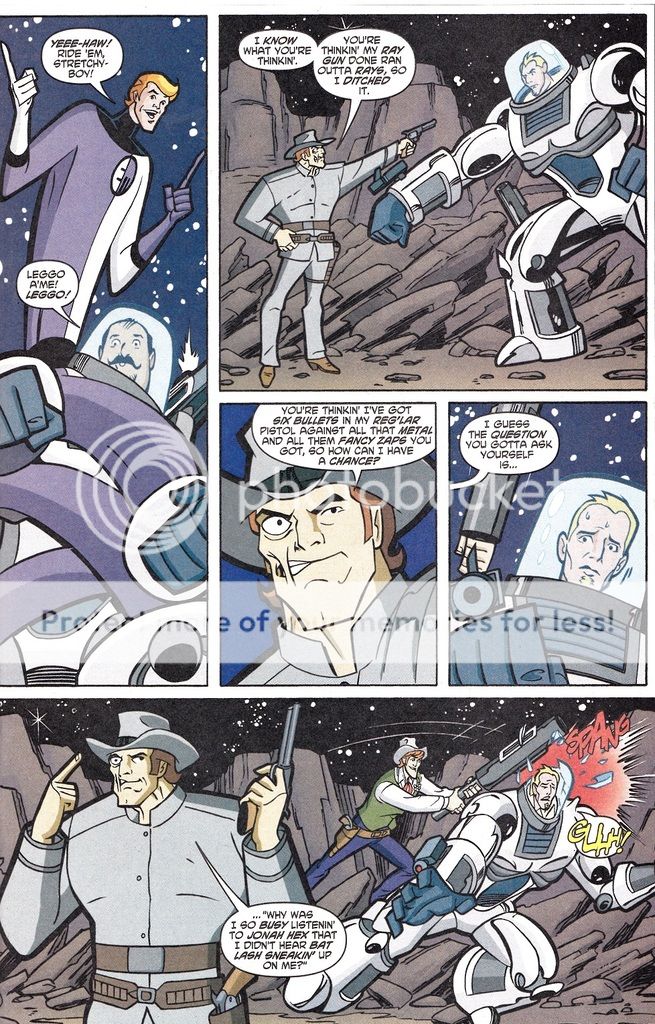
On the heels of that appearance came Jonah’s second foray into animation, guest-starring in an episode of the Cartoon Network series Justice League Unlimited.  On February 22, 2005, “The Once and Future Thing, Part 1: Weird Western Tales” hit the airwaves, and as the title promises, we got to see a trio of League members trotting around the Old West, specifically 1879.  Batman, Wonder Woman, and Green Lantern (John Stewart) are on the trail of Chronos, who’d tried to steal Batman’s utility belt from the Watchtower, but after landing in the Old West, Chronos ran afoul of Tobias Manning -- aka Terra-Man, an old-school Superman baddie -- who swiped Chronos’s time-travel gear and used it to take over the frontier town of Elkhorn.  In order to stop him, the Leaguers team up with Sheriff Ohiyesa "Pow-Wow: Smith, Bat Lash, El Diablo, and Hex.  Though Jonah had already logged in an appearance in the "Timmverse" thanks to Batman: The Animated Series, the character designers for JLU decided to take advantage of this tale being set four years before “Showdown” and give him a look that was identical to very first appearance in All-Star Western #10, right down to the lefthanded gunbelt he originally wore as well as having the cuffs of his jeans cover his boots.  A new actor was also brought in to do the voice work, namely Adam Baldwin, who delivers his lines with the same growl that he used when playing Jayne Cobb on Firefly.  And he gets some of the best ones: when GL asks what the plan is to bring down Manning, Jonah scoffs, “Plan?  We put him in the ground.”  Later on, while they’re heading out to Manning's base of operations, Jonah notices the utility belt Batman is wearing with his otherwise-period-accurate clothes and remarks, “Fancy gunbelt you got there.  I’m thinkin’ you folks are time travelers.”

“Where would you get a crazy idea like that?” Batman asks.

“Experience.  I’ve had an interesting life,” the bounty hunter replies with a smile, making this the very first time Old West Jonah has ever made reference to his previous time-hopping exploits.  And it doesn’t stop with just the one line, either: in the midst of the battle against Manning and his cronies, Hex grabs a rocket launcher and fires it as easy as you please, and afterward, once they’ve trounced the bad guys and are rounding up all the future tech, Hex says in regard to “them fancy ray guns” Lash wants to keep, “Ain’t dependable.  They jam.”  I was lucky enough to speak with series producer and story editor Dwayne McDuffie prior to his death in 2011, and he said that, when writing the script for the episode, he’d slipped all that in for just a bit of fun.  Little did he know that Jonah’s “been there, done that” attitude in regards to time travel would become the standard, at least when it came to the majority of his adventures outside of comics.

The story moves to the future for Part 2, leaving Jonah and his Western pals behind (though Baldwin makes a cameo voicing Hal Jordan), and leaving comics fans even more anxious for any news about the upcoming Jonah Hex title.  Before any progress could be made on that front, however, there was some sadder news to deal with: on May 23rd, 2005, Jonah Hex’s original writer and co-creator John Albano passed away at the age of 82, due to heart attack and stroke.  After parting ways with his creation in 1974, he’d continued to write for comics, eventually moving from DC to Archie, and was even working on a script for an off-Broadway play at the time of his death.  While he was probably aware that a new series was on its way thanks to his royalty contract (which required DC to notify him of any upcoming checks), “in all likelihood, he didn’t care one bit,” according to his grandson, Seth Albano, whom I spoke with in 2017.  “He hated all the Vertigo stuff, and always used to say, ‘You can’t take prestige to the bank.’  Hence why my family kept all of his writing awards; he didn’t care for them at all.”  He does believe, however, that had John Albano lived long enough to see the series to come, “he would have loved every second of it.  He was very enthusiastic about the stuff he liked, and he wrote every story from the ending [to] the beginning; if a movie, TV show, etc. didn’t have a twist ending or at least a good one-liner to close off with he’d complain.  Jimmy’s Jonah Hex stories always had great endings, and the fact that Hex never gets to keep the money is something he REALLY would have gotten a kick out of.”

The Jimmy being referred to is Jimmy Palmiotti, one half of the writing duo that was eventually revealed to be responsible for the latest incarnation of Jonah Hex.  He and Justin Gray first shared writing credits on a reimagining of Chaos! Comics heroine Chastity in 2002, which was soon followed by work on Gen13 and Vampirella, and at the time of the announcement, Palmiotti & Gray were co-writing both Hawkman and their creation The Monolith for DC.  I’ve had the pleasure of chatting with both of them numerous times over the years about their tenure on Jonah Hex, but it wasn’t until an extended conversation in 2017 that I learned the full circumstances behind them landing the gig.  It turned out that, when Didio first let folks know the series was coming, a whole ‘nother creator was on board.  “I think it was mentioned that Brian Azzarello had the character on hold then decided to write his own original series Loveless,” Palmiotti recalled, “and then when we were asked to pitch Jonah Hex and it went through.”  This wasn’t their first time pitching it either, as they’d tested the waters before, but made no progress.  Now that DC had a promised new series with no creative team, though, the powers-that-be gave them a shot.  Both men had been Hex fans for years, with Palmiotti picking up back issues of Weird Western Tales as a kid from a bookstore in Brooklyn (which, coincidentally, employed future DC exec Paul Levitz), and Gray definitely preferring the bounty hunter in his traditional spaghetti Western-inspired iteration as opposed to the “Future Hex” or Lansdale/Truman eras.  Their pitch reflected these old-school tastes, as they framed it as “Punisher in the Old West”, which fortunately landed them the gig, for as Palmiotti said, “at the time we were bottom of the barrel at DC.  We were only given characters that were going to be cancelled or no one wanted.”

One aspect of their pitch, unfortunately, changed right after it was accepted.  Their friend and former Hex artist Mark Texeira was initially on board as series artist, but he soon bowed out because he didn’t want to draw horses.  Since you can’t exactly have a Western without horses, the writing duo was now in a bind, but luckily, Palmiotti mentioned to Steve Wacker -- who was to be the new title’s editor -- that he was enjoying the work of Luke Ross on Dark Horse's Samurai: Heaven and Earth.  When Wacker said Ross was available, Palmiotti was all for it, so the artist became the first of many to help bring Hex to a new generation of comics fans.

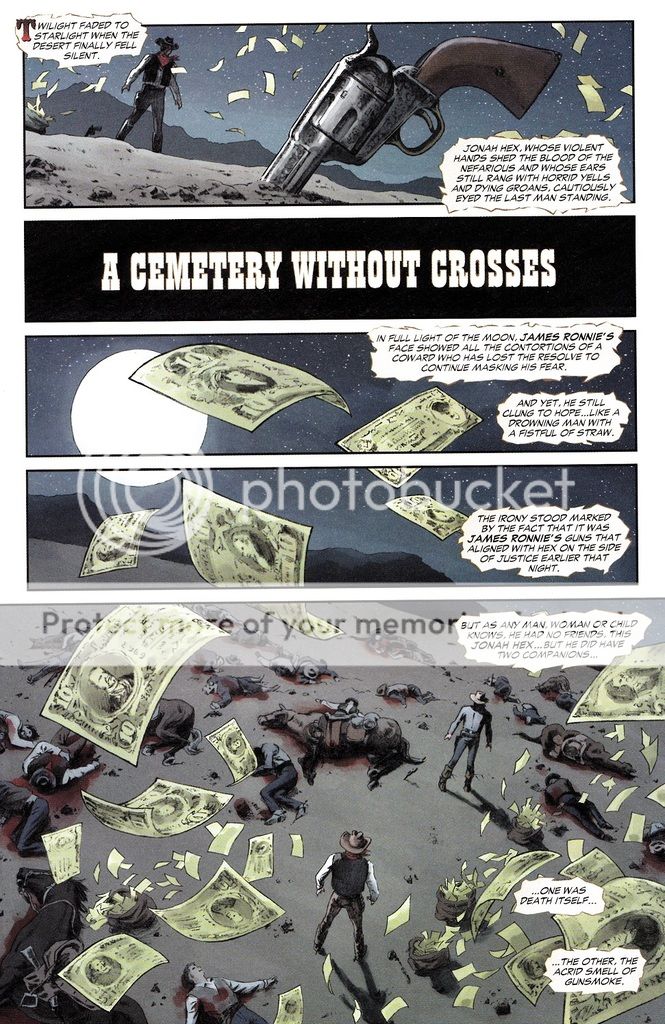
On November 2, 2005 -- the day after Jonah’s 167th birthday -- Jonah Hex (vol.2) #1 (cover-dated January 2006) hit the stands, sporting a Frank Quietly cover and the more "Western" logo briefly used in the early 1980s.  That mix of old and new extended to the interior as well: Ross rendered Hex in the classic style of the 1970s-1980s, but with a photorealistic accuracy that didn’t shy away from making him a doppelganger for Clint Eastwood.  As for the writing, there were two immediate differences in Palmiotti & Gray’s approach, the first being the inclusion of “title cards” throughout: though the credits page will name this story as “Giving the Devil His Due”, the first page presents us with a slim black panel bearing the words “A Cemetery Without Crosses”, thereby giving the scene laid before us its own subtitle (a practice that will carry on not only throughout this issue, but the entirety of the series).  The second difference is the narration boxes: as noted earlier, these had replaced thought balloons starting in the early 1990s, with Jonah first taking them on during his run at Vertigo.  However, the ones we see here do not contain Jonah’s thoughts, but rather are the words of an unseen, unknown narrator, hearkening back to the sort used in comics decades earlier, yet possessed of a literary style more befitting the dime novels of Hex’s own timeframe.  From here on out, the thoughts of our favorite bounty hunter would be off-limits to us unless he chose to utter them aloud, a decision that would serve to bring some mystery back to the character.  Our narrator ain’t no slouch when it comes to Hex lore, either, reminding us that “as any man, woman or child knows, he had no friends, this Jonah Hex...but he did have two companions...one was Death itself...the other, the acrid smell of gunsmoke,” and later remarks how Jonah has been witness to “more than three decades of trials and unimaginable suffering”, referencing not only how long he’d existed as a comic-book character by that point, but also Michael Fleisher’s habit of setting virtually every story in 1875 (a trope that, happily, Palmiotti & Gray would not perpetuate).

In truth, the beginning of JHv2#1 has nothing to do with the main story, but between Jonah’s deadly actions and the knowledgeable narration, those first four pages do serve as a mission statement of sorts, letting new readers know right off the bat what sort of man Jonah Hex is, what sort of world he lives in, and apologizing for none of it.  A different sort of statement is made with the plot of the main story, for it bore striking similarity to the Fleisher-penned JH#1 from 1977.  As Gray revealed, this was very intentional, “because the previous incarnation of Jonah Hex under the Vertigo imprint was one we didn’t want the book to be associated with.  That’s nothing against the Vertigo version or the version where Hex took on the [persona] of Mad Max.  At the time I remember we wanted to send a clear message to readers that this was Jonah Hex as originally envisioned so riffing on the very first issue seemed like a smart way of going about it.”

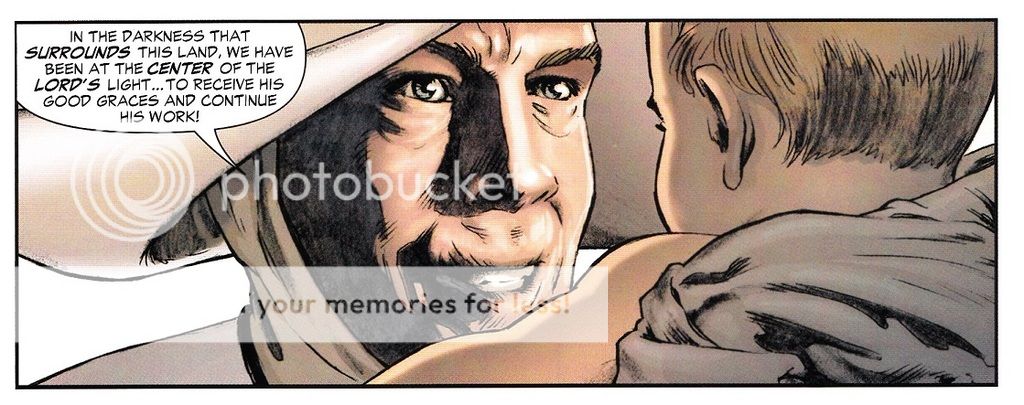
In both cases, the basic spine of the story involves the kidnapping of a wealthy man’s son, but with no ransom demands.  As in Fleisher’s tale, the father is incapable of conducting a search of his own (in this newer case, the father was crippled by an elephant during a hunting expedition -- “Seems fair,” Jonah says when told the circumstances), and Hex is called in to follow a trail that’s several weeks old.  Then and now, the trail leads him to a boy-fighting troupe, with this one being part of a carnival, and the boys have to fight vicious dogs as opposed to each other.  Jonah steps in when their boss, Victor Romanoff, begins beating the kids, and inquires whether they’ve seen the missing boy.  When they tell him no, Jonah leaves, and two of the carnies -- one of whom resembles Matheus Nachtergaele, an actor from Ross’s home country of Brazil -- later try to ambush Jonah at his campsite.  Jonah gets the drop on them instead and forces them to ‘fess up, which leads to one of the biggest differences between this tale and Fleisher’s: the missing boy is still alive, but he contracted rabies from one of the dogs Romanov forced him to fight.  A doctor in Romanov’s employ confirms that the boy doesn’t have long to live, and that his final moments won’t be pleasant, which leads to Jonah making a heart-wrenching decision:


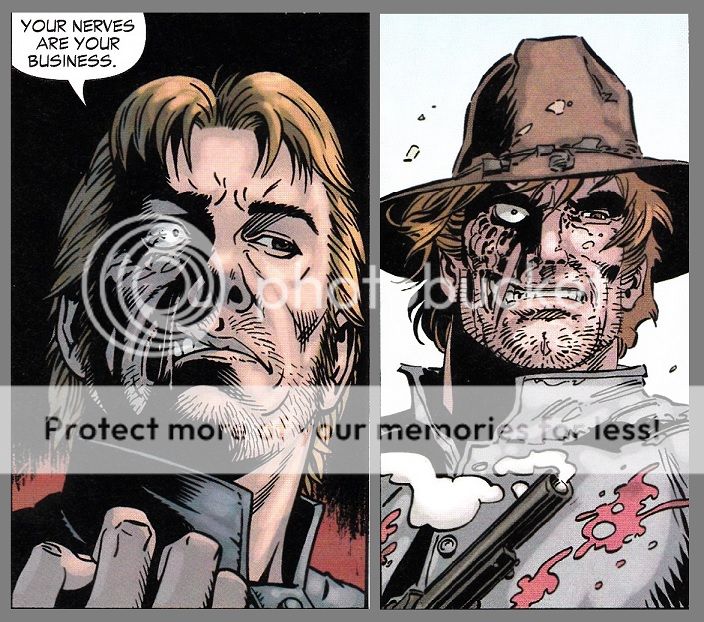
Considering Jonah’s history of punishing anyone who’d dare to harm a child, this mercy-killing must’ve been one of the hardest things he's ever had to do, and likely left a scar on his psyche as ugly as the one on his face.  To be sure, any hatred he felt towards himself in that moment is soon turned directly against Romanov: he strips the man naked, douses him in pig’s blood, and sets loose a pair of dogs who proceed to rip Romanov to shreds off-camera (as before, Jonah’s assessment of things is “Seems fair”).  Though Palmiotti & Gray wanted to distance themselves from the Vertigo years, they managed to infuse just enough of Lansdale’s no-holds-barred sensibilities into the traditional Albano/Fleisher story structure to create something that honored both, as well as taking full advantage of the fact that the Comics Code was all but dead by that point in history (DC finally dropped it from the handful of titles that still carried it in January 2011).  They also brought to the forefront something that was teased at over the years: Jonah’s feud with God.  There’d been many a story under Fleisher’s tenure that included a panel of Jonah addressing the Lord about one unfair matter or another, but this first issue both opens and closes with the narrator commenting on Jonah’s views regarding God, Heaven, Hell, and the bounty hunter’s place within it all.  It will be a subject that comes up multiple times over the next decade, but surprisingly, it doesn’t come up at all in JHv2#2, which concerns a stolen gold cross and a murdered priest (heck, it even begins on Dia De Los Santos Reyes).  The most notable things in this issue are a shot of the numerous scars on Jonah's body other than his face (something alluded to over the past three decades, but no artist had bothered to draw prior to the Palmiotti & Gray era), and a printing error on the second-to-last page that flipped the art but not the placement of the word balloons.

JHv2#3 brings us a new landmark in Hex history by virtue of its special guest star.  Previously, the only way to see Jonah pal around with other DC Western folk was to wait for him to turn up alongside the Justice League or in some other non-Western title.  But in this issue, Bat Lash became the first established DC Western character to appear alongside Jonah Hex in his own title...and just to make it more memorable, we also get to learn how they first met!  The two men cross paths when a crooked sheriff and his pals nail Jonah inside a coffin and send him for a ride over a waterfall (“Maybe he’ll wash up downriver and we can have him stuffed,” one of them says, a sly wink to the Jonah Hex Spectacular).  Lash is witness to Jonah's peril and helps cut him loose from his bonds, telling the bounty hunter about coming across a dying girl whose wagon train been ambushed by white men impersonating Apache.  When Hex informs Lash that those same men are responsible for his trip over the falls, they hatch a plan to bring them all down.  The twist comes when Jonah hauls the sheriff off to face Apache justice: the bounty hunter had been hired by the tribe to prove they weren’t responsible for the wagon train raids.  Lash is somewhat horrified by the sheriff’s fate, but that doesn’t stop him from asking for a share of the reward, later remarking that he could see the two of them “forming a certain kind of profitable friendship...” to which Hex replies that he’s “not interested in making new friends.  I don’t even like the ones I have.”

“You’re kiddin’ me!  You got friends?” Lash exclaims, putting a humorous spin on the bounty hunter’s tagline.  In truth, Jonah had quite a few friends in the industry, including Didio and Sales VP Bob Wayne (who, if you recall, did his own brief take on Jonah in 1990’s Time Masters #3).  According to Palmiotti, if it hadn’t been for those two executives “we would have been off the book and character after a year,” and that it “almost got cancelled about a dozen times.”  Gray concurred, saying that he remembered “being 100% positive that it would be cancelled by issue 12.  By that rationale with the book being single stories we were trying to write every issue as if it were the last.”  He also remembered Tony Moore -- the original artist on The Walking Dead and a big Hex fan in his own right -- told him at the time “not to fuck it up.”

As Gray pointed out, Jonah Hex relied on the old-school “one and done” formula, with the majority of their tales getting wrapped up in a single issue, plus they would sometimes skip forward or back along Jonah’s timeline, not concerning themselves with setting each issue in a precise chronological order.  It was sharp departure from the multi-issue, continuity-tight storyarcs that the majority of other comics presented.  Palmiotti explained, “A lot of that was the idea that we couldn’t find an artist that would stick to a monthly schedule and as well thought westerns were made for that kind of format, being that the original series was done like that.”  Like the narration, it was a throwback to an earlier time, one that they used to their advantage, according to Gray, who said, “Because we were writing stand-alone stories we could have half a dozen issues working at the same time with half a dozen artists.  The joke was that Hex was the easiest book to edit because we were almost completely left alone to do what we wanted with who we wanted.  I can’t imagine that is something that will happen again.  We felt very proprietary about Hex because we were driving not only the content but also a lot of the appearance.  We actively sought out people and could influence the hiring of so many talented people with little or no interference.”

We’ll be talking about those other talented people later, as we still have Luke Ross in the artist’s chair for a few more issues.  In JHv2#4, the team introduces us to the newest recurring character in Jonah’s life: Chako Jones, a young Mexican who damn-near talks Jonah’s ear off as the bounty hunter brings him back to the town of Tall Pines.  Chako is wanted for raping the mayor’s mute daughter, Mayleen, but she soon reveals to Jonah (via a hastily-written note) that Chako is not responsible, so he springs Chako from the jail cell he’d just helped to put him in...an action that leads both of them to an appointment at the gallows.  Chako is hanged first, and seconds before Hex is to follow, Mayleen shows up with a rifle -- after firing a warning shot, she uses it to write a message in the dirt: My father did it!  Seems Chako had been witness to the crime, and the mayor was trying to get him killed before he could tell.  Lucky for Chako, the noose didn’t cinch tight. and they soon cut him loose (but not before we get a shot of him looking like Gary Sinise in The Quick and the Dead).  Jonah leaves town right afterward, glad to rid of the “little mosquito”, but it certainly won’t be the last time he and Chako cross paths.

In the midst of Jonah’s career revival, the modern-day DCU was going through Infinite Crisis, and while it didn’t affect the new series directly (Jonah makes a blink-and-you-miss-it appearance in issue #6 as a resident of Earth-898), the event did resolve a gaping plot-hole in Jonah’s history.  Infinite Crisis Secret Files (April 2006) reveals how Superboy-Prime kept accidentally changing the DCU whenever he punched the crystal barrier that separated him from the rest of reality, and on one page, we can see both the Old West and 2050 versions of Jonah Hex reflected in two different facets.  Writer Marv Wolfman doesn’t give us any specifics, but I’m inclined to believe “Superboy-Prime reality punch” may be the closest to an official explanation as we’ll ever get regarding how Jonah got home from the future (imagine the bounty hunter’s shock when he flipped from one reality to the next in the blink of an eye!).

JHv2#5 was another landmark issue, not just for the story, but the artist: for the first time in two decades, Tony DeZuniga was on hand to illustrate the character he’d co-created.  By this point in his life, DeZuniga was retired from comics, and spent his days doing paintings which he’d sell at his wife’s restaurant in California.  He still made appearances on the convention circuit, though, and Palmiotti approached him at WonderCon prior to the title’s relaunch.  “I went up to him and introduced myself and said ‘I’m a huge fan of yours, and I’m actually writing with a buddy of mine a new book,’” Palmiotti recalled during a chat we had in April 2006.  “And he had sketches he was selling, and I bought one of the sketches of Jonah Hex and said, ‘I’d love to get you to do an issue or a cover.’  And he goes, ‘Oh, I don’t have the time or the energy to do a book, but I’ll do a cover.’  And I called Wacker and gave him all of Tony’s contact information, and all of the sudden...I guess Tony got a hold of copies of the book, maybe.  All of the sudden, he wanted to do one.”  So Palmiotti & Gray wrote a story specifically for DeZuniga titled “Christmas with the Outlaws”, Jonah’s first holiday-themed tale since HEX #18’s “Thanksgiving”.  Set on Christmas Day in 1870, Jonah has to defend an isolated train depot from both the outlaw gang coming to rescue their buddy Mike Harley (whom Jonah captured), as well as from another bunch of fellas out for revenge against Harley.  DeZuniga’s figures were occasionally a little more stout than they used to be, but overall he still delivered on his initial “filthy and dirty” premise he’d come up with 34 years earlier, adding to it some great atmospheric effects and the best close-ups of Jonah's ugly mug he’d ever done in his career.  Over the course of the story, bullets fly, blood flows, and Harley does manage to get away, but Jonah catches up with him ten years later to deliver a special Christmas gift: a Gatling gun fired point blank in Harley’s face.  It’s an ending unlike any ever seen in a Hex comic before or since.


After that lovely image, let’s take a breather and look at Justice League Unlimited #19 (May 2006), which serves as a sequel to Jonah’s appearance in “The Once and Future Thing”.  This time around, Wonder Woman ends up in 1879 with Elongated Man (a wink at JLA#198-199, perhaps?) and Vigilante (Greg Saunders), who join up with Hex, Lash, and El Diablo to prevent Vig’s great-great-grandfather from being killed by the Time Commander.  The art by Gordon Purcell and Bob Petrecca echoes the cartoon’s style perfectly, and as to be expected for a kids-oriented book, writer Adam Beechen has his tongue planted firmly in his cheek for most of the story, up to and including a moment when Jonah does a straight-up parody of Clint Eastwood.  There are some fine character moments for Vigilante, however, and it should be noted that, while this comic isn’t canonical, JLU#19 is the first time Vig and Hex are featured in the same story.

We’re back to Luke Ross for JHv2#6, which delivers on the ever popular trope of "nuns with guns".  On the trail of a murderous woman named Mary Norton (who bears a striking resemblance to Oscar-Award-winner Linda Hunt), Jonah arrives in the plague-ridden town of Salvation, where Mary -- now calling herself Sister Agatha -- has convinced the townsfolk that she’s the only thing saving them from both sickness and the Apache that keep raiding Salvation.  To complicate matters more, one of the nuns in her employ is an old acquaintance of Jonah’s: a young woman named Evelyn, whom he hasn’t seen in seventeen years.  Though there’s no exact date given on this story, we can guesstimate both when it takes place (1876) and when they last parted ways (1859) thanks to a "One Year Later"-related throwaway gag inserted in the solicit for the issue.  Their initial conversation supports the numbers as well, for Jonah comments that Evelyn has “grown into a handsome woman”, and she in turn asks how he got the scar on his face.  This also means that, whatever shared experience they had occurred during the same year that Jonah’s fiancée, Cassie Wainwright, was killed.  It’s a damn shame we don’t get further into it, both because there’s barely any record of that period in Jonah’s life and because what little is said in this issue sounds so interesting (at one point, Evelyn quotes back to him: “If self-preservation is an instinct you possess, I suggest you ride on and don’t stop until the past is behind you.”  What in blazes happened to warrant Jonah saying such a thing?).

Everything gets tossed ass-over-teakettle moments after their reunion, as a soiled dove called Lilly rats them out to “Sister Agatha”, who then orders the other nuns to burn Hex and Evelyn at the stake for their “sins”.  Just has they’re lighting the fire, the Apache attack again, and Jonah manages to free himself in the chaos.  Unfortunately, he’s not fast enough to keep Evelyn from getting terribly burned, and the scene that follows is both beautiful and tragic:


Palmiotti gave Ross all the credit for making that scene work, saying, “Luke caught the look in the eye, and the horror, and the head going back, and you see it in Hex’s face.  The acting was brilliant.”  Ross continued to deliver through the rest of the story as Jonah goes on the warpath, killing anyone who stands in the way between him and Mary/Agatha, although it’s Lilly who ends up shooting her dead.  The last page has Jonah carrying Evelyn’s body to the cemetery and telling Lilly to get a doctor and meet him there.  When she asks if she should bring shovels, Jonah answers, “No.  You’ll be digging with your nails.”

There’s even more carnage in JHv2#7, so much so that it nearly spilled onto the cover: the original solicits featured a grindhouse-caliber image that was soon switched out for a tamer one (both were done by Giuseppe Camuncoli & Lorenzo Ruggiero).  It’s an unusual story in that Jonah’s intended target keeps switching: first it’s a groom on his wedding day that Jonah believes to be a wanted man, then it’s a man who shoots the groom in cold blood for marrying the gal he was sweet on (by the by, the groom really was innocent), and steals a high-quality rifle the bride gave her new husband as a wedding gift.  Jonah pursues the fella for a week, only to see him cut down by nine skunks that took over the town Jonah and his quarry had the misfortune of riding into...and to make matters worse, there’s a wicked thunderstorm ripping open over their heads.  Not giving a damn about anything else by this point, Jonah tells the men surrounding him, “Give me the rifle an’ all a ya live,” but they laugh him off.  Lucky for Jonah, a bolt of lightning hits an oil rig in the center of town, and the bounty hunter starts cutting down skunks left and right.  Unluckily, he runs out of bullets before he can kill the leader, but don’t fret, ‘cause Jonah whips out a surprise from inside his coat: a throwing-star in the shape of a sheriff's badge, the signature weapon of lady gunfighter Cinnamon.  Did Jonah acquire that when they first crossed paths in JLA#198-199, or is it perhaps a souvenir from a later encounter?  Hard to say, but it’s a darn good thing he had it on him.  Too bad the bride ain’t alive to hear all about it when Jonah arrives at her home, having chosen a lethal dose of laudanum over living without her husband.  Always true to his word, he leaves the rifle beside her before departing.

Luke Ross also departs with this issue (though he will supply the cover issue #12), and a few other folks will come and go before we see the one who’ll become the title’s “regular” artist.  JHv2#8 is a bit on oddity on the art front, with Dylan Teague drawing pages 1-13 and Val Semeiks & Dan Green polishing off pages 14-22.  The differences in style and -- most especially -- the depiction of Hex make for a jarring experience.  JHv2#9 more than makes up for it, though, starting with the gorgeous DeZuniga covered rendered in black and white with a literal splash of blood-red.  A great deal of this tale takes place in a fever-dream, as Jonah -- who’s lost a copious amount of blood -- relives a gunfight that took place four years earlier that inadvertently caused the death of a little girl.  DeZuniga’s art on this takes on a wonderful hallucinatory quality, so that the reader has just as hard a time distinguishing illusion from reality as Jonah’s having.  Palmiotti & Gray don’t pull any punches with the story, either, with Jonah later facing the wrath of the dead girl’s mother and (in that twisted way you only get in Jonah Hex stories) making amends.  On a side-note, there’s a tombstone in the background of one panel with the name “Patrick Wedge” on it, the first of many shout-outs to actual Hex fans the writers snuck onto the pages over the next decade.

Phil Noto -- who gave us a great cover on issue #3 -- moves to the interior for JHv2#10 (and like issue #7, this one also had a different cover shown in the solicits).  As with Palmiotti & Gray’s first outing, this issue shares similarities with another classic tale, specifically 1978’s JH#12, wherein Jonah tussles with some swamp folk.  In this case, Jonah goes into said swamp to avenge the death of a black man whom no one else seems to care about.  He soon finds the family responsible and learns that the victim’s wife is still alive, but their baby was fed to the gators (bad move!), and they immediately try to do the same to Jonah (even worse move!).  Unbeknownst to them, Jonah survives the ordeal, then shows up on their doorstep to teach them a lesson...and we should be glad that the majority of it happens behind closed doors.


David Michael Beck illustrates his first Hex story in JHv2#11, and we also get our second guest-star in the form of El Diablo, as well as our first bit of continuity for the new title when the two of them cross paths with some of the carnies from issue #1, who want to get even with Hex for killing their boss, Victor Romanoff.  This version of El Diablo is slightly different from what we’re used to, as it forgoes the idea of Lazarus Lane being a catatonic invalid during the day, and Wise Owl is nowhere to be seen (we’ll presume this is due to the events of 1989’s Swamp Thing #85).  For the first time, we actually get to see Lane as himself, attempting to have a semblance of a life when El Diablo is slumbering within him (to be sure, they are two separate entities, with the demon only coming out when Lane is unconscious).  We can also deduce that the story takes place after JHv2#3, for Hex makes a passing reference to Bat Lash, and Lane asks, “How is that scoundrel?”  It’ll be another year before we see the three of them together, so we’ll just move on to the rest this story.  The carnies try to hang Jonah, but El Diablo rescues him, and the two men go out the next night to extract vengeance, only to find some other fellas beat ‘em to it.  Seems Romanoff was paying protection money to the Pearson gang, and with him dead, they’ve decided to extract payment from the freaks.  El Diablo and Hex stop the gang from killing all of them, but the demon then has to stop Jonah from slaughtering the rest.  “They have suffered enough, Hex.  To kill them would be of no importance,” El Diablo tells him, then points out that, by having previously killed Romanoff, he’s partially responsible for the gang’s rampage.

Before Jonah rides off, one of the carnies -- a tattooed woman who claims to have “the sight” -- says he’s no different from herself or the other freaks, and that “Some day they’ll put you on display and people will pay money to stare at the dead body of Jonah Hex.  You’ll be a sideshow attraction!” to which the bounty hunter simply replies, “If ya could truly see the future...then why didn’t ya stop all this from happenin’?”  The reader, of course, knows all this will eventually come to pass...and if this story takes place after Jonah’s trip into the future, he may know as well, presuming his memories of 2050 are intact post-Infinite Crisis.

While there’s no explicit date on the story in Jonah Hex (vol.2) #12 (December 2006), it’s inferred by some of the dialogue that the event depicted led to Jonah becoming a bounty hunter.  We’ve covered this ground before -- in 1979’s JH#30-31 and 1987’s Secret Origins #21 -- but I think we can easily integrate this new information in with the rest, placing it after Jonah getting humiliated by veteran bounty hunter Arbee Stoneham.  Jonah’s travelled all the way to Utah, only to nearly freeze to death up in the mountains.  He’s soon rescued by a group of Mormon settlers who have problems of their own.  A local general store owner named Dice not only refuses to sell them any supplies, he’s hired a group of bounty hunters to kill every last Mormon up in the mountains.  Noting both his uniform and large supply of guns, the Mormons try to talk Hex into killing Dice, but he instead does his best to act as intermediary, going to the general store and requesting simply “Fifty pounds of beef an’ all the blankets ya have ta sell.”  Dice knows exactly why Jonah’s there, and proceeds to tell him about the Mountain Meadows Massacre, a real-life event in 1857 that did nothing to help folks’ opinions about Mormons.  The bounty hunters then show up and force Hex to lead them to the settlement, only to find an ambush waiting for them -- most of the bounty hunters are shot down by the settlers, and Jonah polishes one off himself.  Once the fight is over, Jonah confronts the Mormon leader about his actions, both on that day and in 1857.  The man points out that what he did -- though he’s not proud of it -- isn’t much different than what Jonah himself did during the War.  The man’s words must’ve struck a chord with Jonah, for this time he does strike up a deal with the settlers, then pays Dice one last visit, a scene rendered in fine detail by Paul Gulacy:


It appears the events of this new story were the last push Jonah needed to fully take on the role of bounty hunter.  With the incident in SO#21, he collects a bounty by sheer dumb luck, and in JH#30-31, he’s first pressured into participating by the law, then he does it voluntarily in the hope of saving his friend (which he fails to do).  JHv2#12 would be the first time he truly takes on a bounty for pure financial gain, with the added incentive of knowing that he’s protecting innocent women and children (something that’ll influence his decisions for many years to come).  Had the series ended there as Justin Gray feared it might, this would’ve been a fine capper to the run.  Thankfully, he and Jimmy Palmiotti were allowed to go on bringing us new adventures every month, and as they moved into their second year, the writing duo expanded their scope, delivering longer stories and more insights into Jonah’s past, along with (dare we say it?) finding the ornery ol’ cuss a soulmate.

ERRATA: The same day I posted Appendix B, I was alerted by my friend and Matching Dragoons blogger Dwayne Hendrickson that I totally omitted Jonah's adoptive Apache family.  I corrected the oversight a couple of days later.

<< Part 14   |   Index   |   Part 16 >>