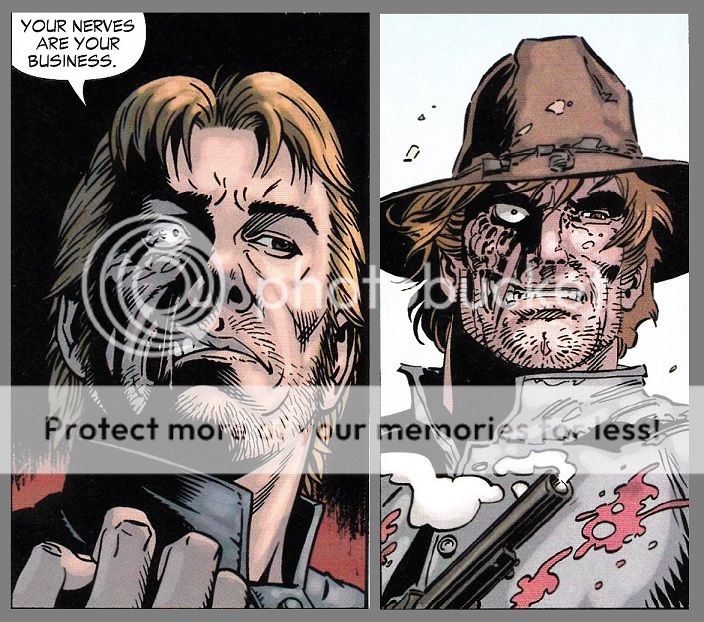
As
I’d hoped, my previous blog post did spark some conversation about who Legend
really is, with at least one name tossed out that I hadn’t considered.Since we’ve covered all the possibilities of
the female persuasion (though I did miss a few the first time out…head on back and scroll to the bottom to see who I added!), I thought I’d go over all the
men-folk this time, just in case I’m barking up the wrong tree with that “Don’t
blame a girl for wishing” comment. Now, before I get started, let me cross one
name off the suspect list, despite having multiple run-ins with Hex: Swamp
Thing.Seriously, the two of them have
crossed paths three times over the past 36 years, but if you’re gonna try and
convince me that big ol’ Swampy squeezed himself into that armor without
anything oozing out, you’ve got a serious uphill battle, kiddo. And for those wondering why the Lord of Time isn’t on here, even though he’d
seem like the #1 contender for Legend due to him fucking with Hex on two
separate occasions…that dude was slaughtered within the first few pages of the Justice League: Dark Tomorrow Special.Seriously, one of them Omega Demons punched a
hole though his chest.Seems he changed
his name to Epoch at some point -- a fact I learned when checking up on his
status for this post -- so I didn’t know it was him when I read the comic.Damn shame, as I was formulating an “Iron Lad
from Young Avengers” situation in my
head. Okay,
same rules as last time, minus the presumption that Legend is female.Here we go... SUPERMAN: Only
a single meeting near the end of J&J’s All-Star Western run, but we’re
counting it. I don’t know about you, but
I seriously doubt it’s him, if only because we already have at least two
Supermen running around by the end of the “We Are Yesterday” arc. Why add another, especially one that appears
to be rather non-super? Also, Supergirl
was listening to Legend’s heartbeat to see if they were telling the truth, and
something tells me she’d recognize that heart as her cousin’s. BATMAN: Bruce
had a Black Lantern version of Hex as his righthand man during Dark Nights; Death Metal, they teamed up
in the Batman Giant Walmart series,
he sprang Jonah from jail during the aforementioned ASW, not to mention the
bounty hunter’s associations with the Waynes during the 1880s…fuck, Hex is pretty
much honorary Bat-family at this point!
All that being said, there’s the same issue here as with Superman --
multiple Bats running around, so why add another? -- plus Legend’s dialogue
doesn’t 100% ring true as Bruce’s. The
real clincher for me dismissing Bruce as a suspect is how he talks about Helena
Wayne aka Huntress as being “Batman and Catwoman’s daughter”. Not his
daughter. So does Bruce compartmentalize
his thoughts that damn much? Maybe. You know who might think of Helena that way,
though? THE BATMAN OF 2050:
A longshot only in the sense that he was presumed dead after his last
appearance in HEX, but there was no dead body shown, and know you the rules of
comics, folks. The idea of our time
traveler being the historian who found the Batcave after Bruce’s death and
resurrected his legend (pun intended) after the bombs dropped in 2045 seems
very plausible. If he could find the
Batcave, he might also find one of the old Justice League HQs and some time
travel equipment, then try to stop the apocalypse before it happens (see what I
said about Stiletta in the previous post).
We’re also back to the “helmet points as bat ears” notion, which would
also apply if Legend does end up being Bruce…yeah, I’m gonna keep bringing up
this vague feature until we find out who’s under that helmet. STANLEY HARRIS: This
one was suggested by Dwayne Hendrickson of Matching
Dragoons, and admittedly, this didn’t occur to me prior to my concentrating
solely on female suspects, and I kick myself for not thinking of it. The time-displaced Vietnam soldier who
begrudgingly teamed up with our favorite bounty hunter during HEX, Harris would
eventually be given superpowers and drafted into the Dogs of War (“As far as
‘rag tag’, ain’t nobody more rag tag than the Dogs of War!” Dwayne said, and I
wholeheartedly agree). Last seen taking
off into space with his team in order to head off an alien invasion, there’s
nothing to say he couldn’t have gone bouncing through time afterward. However, I will dismiss one clue that Dwayne
pointed out, namely the coffee-colored sleeves of Legend’s armor. Dwayne believes that to be bare skin (Harris
being African-American), but that same color is present on the lower half of
the suit, especially over the crotch. So
unless Legend has the features of a Ken doll and is walking around pantsless,
I’m presuming they’re completely covered, with no bare skin at all
showing. Damn shame, as narrowing down
their race would’ve trimmed the list even more than narrowing down their
gender. BOOSTER GOLD: Another
suggestion, this time by Darren Schroeder of the Jonah Hex Corral and founder of the Jonah Hex, Via Pony Express Facebook page. While I personally dismissed Booster as a
cheat since he’s already a time traveler, Darren pointed out that “he’s always
doing that ‘fake ID cause I don’t want to get caught or break time’ Kind of
B.S.”. Good point, Darren. I’d still consider it a cheat, but then
again, Jonah slugged Booster real damn hard last time they saw each other in ASW,
so yeah, I’d want to hide my face too and avoid a repeat. THE FLASH: Barry
Allen has encountered Jonah twice, and he certainly has more than enough
time-travel experience, but unless he’s become depowered, I don’t know why he’d
be depending on a timeship instead of just bopping through the Speed Force like
usual. Low odds. GREEN LANTERN(S):
My mind is mainly on Hal Jordan here, but John Stewart got to meet Hex during Crisis on Infinite Earths, so we’ll
group the two Lanterns together. For
sure, both Hal and John have experience with “failure and redemption”, and
there’s always the possibility of them losing their rings and having to rely
more on tech. HAWKMAN:
Same rationale as Hawkgirl, this time via his former incarnation of Nighthawk. On a side note, do you realize how damn nuts
it is that Jonah Hex knows so many classic Justice League members? I bet there’s actual people in the League
that haven’t met as many as him! STEVE TREVOR: In
case you didn’t look back at the previous post for my revision, I added Wonder
Woman and a few others due to Hex running into them in the Walmart Justice League/Wonder Woman Giant
titles. One of the few men in that
storyline -- other than ol’ Jonah, of course -- was Steve Trevor, and though
they barely even spoke to one another, I’m adding him to this list just to be a
completist, as I seriously doubt he’s Legend.
Be a nice surprise, though, giving him some character development
unrelated to the Amazon. JOHN CONSTANTINE: Near-zero
odds because Legend doesn’t swear enough, plus Constantine isn’t one to rely on
technology. Okay,
pretty sure I’ve got all the angles covered this time.Once again, comments are encouraged, and more
posts will come when we learn anything new regarding Legend and/or Jonah Hex.Really hoping we get something in the next JLU issue, because I hate waiting!
As mentioned back during
our overview of the Fleisher era, one of the most important lessons Jonah
learned from a young age was how to endure just about anything life -- and more
specifically, his father -- could throw at him.Gray & Palmiotti gave us a clear example of that lesson being put to
good use in Jonah Hex (vol. 2) #42 (cover-dated
June 2009), half of which is flashback to Jonah’s childhood in Colorado,
rendered beautifully as always by Jordi Bernet.In an effort to physically strengthen his boy, Woodson Hex tied rocks to
young Jonah’s arms to weigh them down, then made him stand out in the yard all
night.Pa imparts a little family
history during this (as we’ve discussed elsewhere) before falling into a
drunken stupor, after which Ginny sneaks out and unties Jonah for a while to
give him a respite from this new torture.This earns Ginny a beating the next morning when Woodson finds out, and
he later drags Jonah into town, muttering that he never wanted children, but
that doesn’t mean he’s going to let her turn the boy “inta a daisy”.
Jonah soon gets a chance
to prove himself when a group of older boys approaches him, asking, “What’s yer
name, puke?”, to which Jonah replies that he “ain’t a Missourian” , in
reference to the nickname folks from that state earned back in the 1820s (this
throwaway line will take a new twist in about 4 years). His denial doesn’t stop the boys from giving
him a whuppin’, and when Woodson finds out, one would think the man would
perhaps give Jonah a few licks of his own for not coming out on top, but
instead Woodson seeks the boys out and pistol-whips the entire lot of
them.“Never look fer trouble with a
Hex,” he tells them once he’s done, and later on says to Jonah, “Nuthin’ should
humiliate ya more than havin’ yer father fight yer battles!”Young Jonah takes those words to heart, but
probably not in the way Woodson intended: seeing as Jonah’s biggest battle at
this point is with Woodson himself, he takes a whiskey bottle one night and
pisses in it, then puts it within reach of his drunken father so he can watch
the old man unknowingly take a swig. Cut to a couple of
decades later, where the adult Jonah is facing off against three of his former childhood
tormentors, now grown and looking to get revenge on Hex.Having weighed his arms down with chains and
iron balls, they figure there’s no way Jonah can draw his guns...but of course,
Jonah is fully capable, thanks to what Woodson did to him all those years ago.After Jonah shoots his assailants (not to
mention bludgeoning one of them with the very ball-and-chain they’d encumbered
him with), we get the biggest surprise this tale as to offer.All throughout the “present-day” scenes, an
old man can be spotted in the background -- as Jonah walks away, the old man
thinks, “That boy is a mean son of a bitch”...and the reader realizes this is
Woodson Hex himself, bearing witness to what his abusive “lessons” had finally
wrought. Paul Gulacy returns in JHv2#43 for a mostly-silent issue containing a fair share of violent
deaths and barely-obscured nudity...in other words, it ain’t exactly
kid-friendly, which is ironic since it hit the stands around the same time that
a third cartoon iteration of Jonah Hex was on the airwaves.Batman:
The Brave & the Bold was a star-studded series on Cartoon Network that
teamed the Dark Knight with various and sundry DC characters in every episode,
but with a lighter tone than we’d seen during the “Timmverse” era.Surprisingly, Jonah not only got to be a
guest-star on the show, but he’s also featured in the title sequence of every
episode!His first in-story appearance
was on February 20, 2009 in the opening “teaser” for the episode “Return of the
Fearsome Fangs”, wherein he and Bats take on an Old West version of the Royal
Flush Gang.Sadly, Jonah doesn’t get to
participate in the main story, but a few months later (June 12th, to be
precise), Jonah was front-and-center for “Duel of the Double-Crossers” as he’s
forced by Mongul -- who apparently saved Hex’s life, thereby putting the bounty
hunter in his debt -- to capture Batman and bring him to Warworld’s gladiator
arena: Later on, as the title
suggests, Mongul reneges on his deal to return Jonah to his proper time, so our
favorite bounty hunter frees Batman and the other prisoners, sacrificing the
time machine in the process. In both
appearances, Jonah is voiced by Phil Morris, best known for his recurring role
on Seinfeld as lawyer Jackie Chiles.Morris (who also voiced the
villainous Fox in “Return of the Fearsome Fangs”) gave Hex a harsh-yet-clear
voice, and always added a tinge of sarcasm when appropriate, such as when tells Batman in their first meet-up to get a proper cowboy hat
because he “cain’t be partnering up with someone who parades around in thet ridiculous
bat getup!” Speaking of which, Jonah's own
outfit in this series is traditional but with a Dick Sprang influence to the
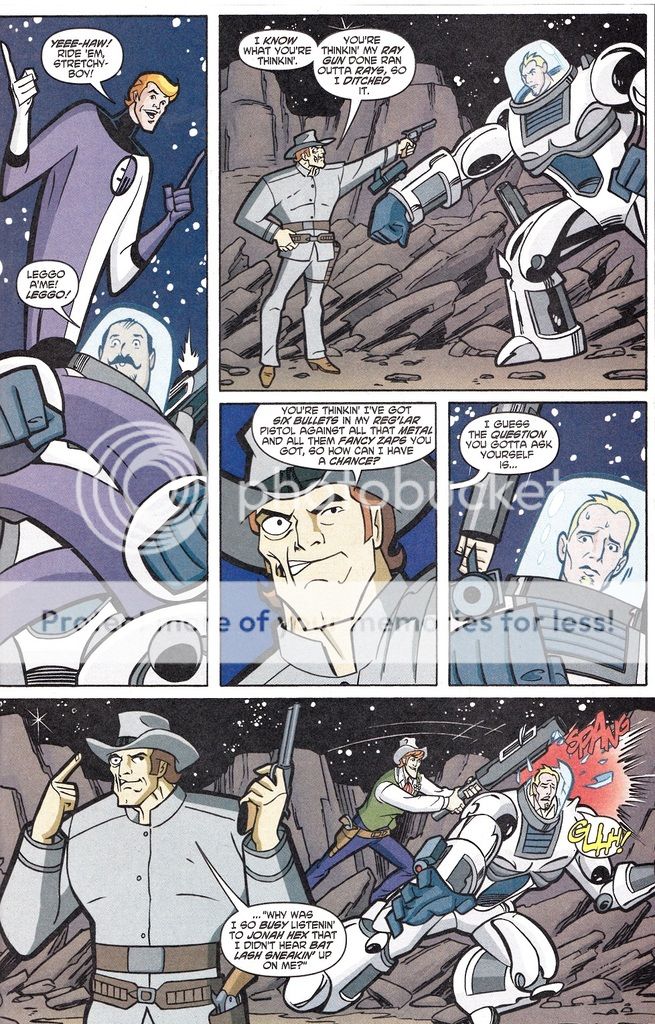
linework, matching the look of the entire series. And just like in his JLU appearance, Jonah is
quite familiar with time travel, and even sports a pair of laser-zappin’
six-shooters (which appear to be rather dependable this time around). There’s also a hint of his way with the
ladies in “Duel of the Double Crossers” when Hex and Lashina -- who’s also
working for Mongul -- go from down-and-out brawling to something a mite more
frisky, leading to them riding off into the sunset together by the end of the
episode (keen-eyed viewers can also spot Hex making silent cameos in “Siege of
Starro, Part One” and “Mitefall”).
Back
in Jonah’s own title, Jimmy & Justin switched their tactics for a spell:
after nearly four years of writing single-issue or two-part tales, they
presented fans with a six-issue arc titled (naturally) “The Six Gun War”, drawn
by Cristiano Cucina. Sadly, neither of
them actually had any desire to write the story, as I learned during one of our
talks back in 2017. Palmiotti flatly
admitted that “DC had pressured us
into doing it, thinking if the stories were continued, they would sell more.” Gray concurred, saying, “‘Six Gun War’
was one of the few times when we were directed, because of weakening sales
brought on by a publishing incentive that strangled anything unrelated to the
core superhero line, to craft a specific kind of story that was intended to
feel like DC’s version of a Wild Bunch movie. All the main characters had to
play a role, but ultimately I still feel like those six issues are not as solid
as the rest of the run.” Despite being
forced into this situation, the duo used it to bring back to the comics page
two classic Hex villains, as we’ll soon discuss.
JHv2#44 opens on a rather odd sight, as
a tornado makes its way across the Texas plains, tossing Comanche and their
mounts this way and that. Hex manages to
avoid the bodies raining down upon him, and when the skies clear, he meets up
with Major Newberry, who summoned Hex to help with the aforementioned Comanche,
but it turns out it was all a trap set up by Quentin Turnbull, who we haven’t
heard from since Jonah Hex #85, well
over 25 years ago. He’s teamed up with
El Papagayo to take down Hex once and for all...which is an odd thing,
considering the last time we saw Papagayo (the real one, not the robot in HEX #1), he damn-near killed Turnbull
just for being in close proximity of Jonah (go flip through JH#81-82 if’n ya
need a refresher). But it appears the
old man and the bandito have since bonded over their mutual hatred of the
bounty hunter, and proceed to shoot and beat him until they’re satisfied that
he won’t live much longer, then bury him alive in a cemetery. Lucky for Hex, some grave robbers come by and
dig him up before he suffocates:
The story then jumps ahead two weeks to a saloon in Chihuahua, Mexico, where Bat Lash gets his butt saved by Tallulah Black after some cheating card-players don’t take kindly to his superior skills. As they vacate the premises, they run into El Papagayo, and we soon learn that he’s very familiar with Bat Lash, as he and Hex apparently busted up a gun-running scheme of Papagayo’s some time ago. The bandito brags about killing and burying Hex, then decides he should do the same to Lash and Tallulah, so his men lasso them and begin dragging them through the street. Elsewhere, Jonah staggers into a town that was slaughtered by Papagayo, save for one soul: Lazarus Lane, who’s locked up in a jail cell. Jonah passes out cold before he can free Lane, though, so at the beginning of JHv2#45, El Diablo -- who can slip out of the cell with no problem -- rouses Jonah and has him move Lane’s body since Diablo can’t touch him After the two of them compare notes, Diablo forcibly insists on joining Hex in his quest for vengeance, due to what Papagayo and his men did to the town.
Back in Chihuahua, El Papagayo’s men try to have their way with Tallulah, but once they strip her naked and get a look at how badly scarred she is, none of them can bring themselves to do it. Even Papagayo himself has to walk away from the sight (not to mention her cruel taunts), after which he orders his men to toss her in with Lash, who’s been beaten bloody. The two of them begin to hatch an escape plan, unaware that Jonah Hex and Lazarus Lane are making their way towards the town. Before they get there, they run across a band of Comanche warriors, the only ones who remain of the tribe Turnbull used for bait. Their leader, Blue Eagle, is also eager for revenge, and tells Hex that Turnbull is down in Mexico mining for gold, which explains what he’s doing so far away from his Virginia plantation. As they continue on to their destination, Lash and Tallulah make their escape, but are quickly caught. Papagayo decides he’s had enough of their shenanigans, so he lines them up against a wall and is about to have his men shoot them...but Hex and his new posse ride in on the first page of JHv2#46 and take out the firing squad before that happens. Jonah himself runs down El Papagayo and takes him captive, but not before shooting the bandito’s beloved parrot out of the air.
Once all the fighting is over, Tallulah runs up to Jonah, leading to the bizarre sight of them kissing each other, then her slapping him and calling him a bastard, then more kissing, then him shoving her off. “I shudder to think of the unholy offspring the pair of you would bring into this world,” Bat Lash quips, an innocent throwaway line that’ll carry a ton of weight in a few issues. We’ll get to that later, though, as we need to get over to Turnbull’s compound, which is located deep in the jungle near what looks like an ancient Mayan ruin. One of Papagayo’s men got away and has warned him that Hex is very much alive, but Turnbull apparently counted on that -- makes sense, seeing as how Hex has survived multiple attempts on his life by Turnbull over the years -- and summoned a half-dozen skilled fighters from around the world to take on the bounty hunter. Why Turnbull didn’t just send them after Hex to begin with is unclear, but no matter, we’ll get to them soon enough. After Jonah sets El Diablo to the task of torturing El Papagayo for information, he and Tallulah bed down together -- during a break in their lovemaking, Tallulah says to him, “This Turnbull bastard has ya mighty vengeful an’ full up on hate.Reminds me a’ me not that long ago.”Jonah only tells her that the matter goes back to the War “with a fair amount of unresolved bloodshed” and nothing more, but for the reader, the story shifts to a retelling of the Fort Charlotte Massacre in 1863, one that hews close to the original version in Weird Western Tales #29, even going so far as to make him a member of the 4th Cavalry once more.Though Gray & Palmiotti don’t borrow Michael Fleisher’s dialogue word for word, certain turns of phrase do jump out, like Jonah saying he’ll spend the rest of the War “twiddlin’ muh thumbs”, which is present in the original and Jonah Hex #35.Another thing that jumps out is a huge continuity error, as Jeb Turnbull comments that, once the War is over, Jonah doesn’t have a home to go back to, saying, “You think them Apache gonna take ya back?After ya killed their chief’s boy?”Since we all know that Jonah won’t kill Noh-Tante until 1866 -- not to mention it’s the incident that led to him receiving the “Mark of the Demon” -- we’re gonna have to ignore this flub, as there’s no real way to reconcile it.The rest of the flashback plays out the same as it has before, though it does omit the bit about the fort’s commander (who we finally find out was named Tennison) letting the prisoners escape so he can kill them all in the attempt, and it refers to the red clay splashed on Hex’s horse as simply “mud”, thereby removing the significance of it (however, Cucina does make the soldier who discovers it Black, as he was in the original version).Also, while Hex killed that Union commander at the end of WWT#29, here he killed a fellow Reb that kept calling him a traitor.Overall, it sums up well for new readers why Quentin Turnbull wants Jonah dead, though they probably should’ve referred to Jeb by his last name at some point in the flashback, just to make the connection between father and son more clear. By the beginning of JHv2#47, they’ve gotten the information they need out of Papagayo, so Hex and the others hit the trail, leaving the bandito broken but alive and hanging like a piñata outside the saloon.After a brief shootout with a band of Mexicans -- which is peppered with some grand insult-filled banter between Jonah, Lash, Tallulah, and Lane -- they reach a small town about six miles from Turnbull’s compound and decide to stop to get a drink at the saloon.While there, who should appear at Jonah’s elbow but Chako Jones, last seen in JHv2#20.Seems he knows about the trap Turnbull is laying for them, including the paid killers, so Jonah sends Chako outside to inform Blue Eagle and his men, who are standing guard.That night, Jonah awakens to find all the Comanche have been slain, and we learn in the opening pages of JHv2#48 that the “little mosquito” is working for Turnbull!“How many times can a man kick a dog before the dog bites the man?” Chako asks Hex with a smile as the killers emerge from the shadows:
The majority of the issue is taken up with Hex fighting off his attackers one by one.First up is a pair of whip-wielding femme fatales who knock Jonah off his pins so a Persian assassin and a Masai warrior can move in and finish him off. Unfortunately, they made the mistake of bringing knives to a gunfight, and both earn bullets in their braincase.The women quickly move in with knives of their own, and though they manage to draw blood, Jonah gives ‘em matching bullet holes in their knees.Then comes Mike Flannery, a burly Irish boxer who’s familiar with Hex’s reputation but isn’t impressed.“I heard ya knocked out a trained pugilist with a single blow,” Flannery says -- a reference to a scene in JHv2#24 -- as he lays a couple of rabbit punches on the back of Jonah’s skull.That doesn’t stop Jonah from stabbing Flannery in the leg. bringing the Irishman low so the bounty hunter can scalp him.Thinking the fight is over, Jonah tells the two women to go back to Turnbull and tell him “his money can’t buy me a grave.”As they hobble off, Jonah goes over to Chako, who’s laying the street thanks to a bullet Hex planted in his leg earlier.Chako begs for his life, but Jonah soon realizes he’s just acting as a distraction for the last killer, a huge Mexican.Jonah shoots Chako in the head before opening fire on this new target, who deflects the bullets with a pair of machetes.Deciding that it’s time to go old-school, Jonah grabs a tomahawk from his saddlebag and proceeds to hack and slash the Mexican until his opponent finally falls dead. Bleeding and possibly concussed, Jonah staggers back inside the saloon and awakens the others, who somehow managed to sleep through the whole ordeal.After getting patched up between the end of this issue and the beginning of JHv2#49, our four remaining cowpokes make the final leg of their journey to Turnbull’s compound.Looking down upon it from a nearby cliff, Bat Lash observes that they’re outnumbered thirty to one, but Hex and Tallulah point out something he didn’t consider: all the locals Turnbull has enslaved to work in the mine.All they have to do is get those people on their side, and taking over the compound should be easy.Knowing that Lazarus Lane is badly suited for this mission overall, Jonah literally chokes him out so he can rouse El Diablo from inside the man and send the demon to free the miners.After moving Lane’s unconscious form to safety, Jonah, Tallulah, and Lash gallop in for a direct assault on Turnbull’s compound.Gunfire and dynamite soon sets everything ablaze, and Turnbull escapes in the chaos with Hex hot on his tail. Unlike previous encounters between the two men, Jonah decides he’s through pulling his punches with Turnbull, opening fire on the man’s horse and belting him good across the face once Jonah reaches him.Surprisingly, Turnbull isn’t the helpless old man he’s always been portrayed to be, as it’s revealed that the eagle-headed cane he always carries contains a stiletto blade in its tip, which he uses to repeatedly stab Hex with until the bounty hunter breaks the blade and makes ready to stab Turnbull himself with it.“Ah didn’t kill yer boy, but Ah don’t care anymore!Yore gonna die now, old man,” Jonah yells, but before he can dispatch his longtime foe, a posse rides up and demands he release Turnbull.As is his way, it appears Turnbull pulled some favors with the Mexican government and arranged for an escort across border...and if Jonah kills Turnbull in their presence, he and his friends will die very quickly.So Jonah drops the blade and lets him ride off, but he promises Turnbull that he’s not done with the man.Indeed, they will cross paths a few more times in the years to come, with two of those meetings being in entirely new venues for both of them. Looking at these six issues as a whole, you can see the story was padded out a bit, which is sadly common in an era when “writing for the trades” is encouraged by the major companies (this has also led to an increasingly-common habit of “waiting for the trades” by fans).Nearly every issue has a scene that could be cut due to having little bearing on the story overall -- in fact, Blue Eagle and his men could be excised altogether since their main purpose appears to be cannon fodder, and not even in the final battle at that -- meaning you could theoretically reduce this arc to five or perhaps even four issues.It’s possible some fans came to a similar conclusion at the time, because when looking at the sales numbers for the title during the “Six Gun War” arc, there’s only a brief uptick of an extra thousand copies in the midst of it before the number settles right back down to a little over 11,000 copies a month (if you recall, Jonah Hex was moving about 14,000 copies just a year prior).For all the pressure DC put on Jimmy & Justin to deliver an ongoing story, “Six Gun War” barely moved the needle. Though it sounds bleak, DC still appeared to have faith in Hex, as they chose him as the subject for the company’s annual holiday card. Not usually seen by fans, these cards were sent to out to licensors and comics shops in late 2009, bearing the signatures of various DC execs like Bob Wayne, who was apparently still championing for Hex in his position as Sales VP. In previous years, the cards were illustrated by top-notch artists like Alex Ross and Bruce Timm, and this one was no exception, for they drafted the legendary Jose Luis Garcia-Lopez to render an image of Hex on horseback, his saddlebags loaded with toys as he looks down a hillside at a snowy cabin, a single star lighting the entire scene. One could go so far as to think of it as an epilogue to the Hex tale in the Super-Star Holiday Special three decades prior, and imagine Jonah is bringing gifts to the little girl whose pet fawn he’d saved in that story.
Another sign of faith was JHv2#50, an extra-large issue that was the first in Jonah’s career to come with a variant cover, both of which were done by returning interior artist Darwyn Cooke (Cooke’s presence may also be why the sales on this single issue spiked to over 15,000 copies).The stark contrast of the covers perfectly captured the two plot threads running through the story, with the variant showing Jonah surrounded by flames and a swirl of wanted posters, while the main one has a remorseful Jonah kneeling in front of a small grave.No matter which of these the reader got in their pull box, the images were certain to grab their attention. Presumably taking place not long after their reunion in “Six Gun War”, the story opens with Jonah and Tallulah taking down a band of outlaws, then celebrating their newly-acquired bounty at a local saloon.“Come back in the mornin’...not too early,” Tallulah tells the barkeep after the duo has driven everyone else out of the saloon and paid said barkeep for his trouble.Though we don’t get to see the randy night that follows, we are treated to the (shadowed) image of Jonah waking up stark naked the next morning, sprawled across the top of the bar and very much alone.Seems Tallulah rode off at dawn, and while Jonah is still contemplating what to make of that, a man by the name of Mr. Green comes up to the now-dressed Hex on behalf of his wealthy employer and asks Hex to participate in a massive bounty-hunt involving fifty wanted men, each worth two thousand dollars and all belonging to a gang that, among other crimes, killed his employer’s youngest son.Jonah replies with a grin that his price is three apiece, but Mr. Green tucks the folio full of bounty posters under Hex’s saddle anyhow, saying his employer may be willing to pay more if Jonah brings in the majority himself, seeing as there are other parties working on this and there is no set time limit. The next two pages are a montage of Jonah capturing and/or killing various owlhoots, some in downright humorous ways. It also serves as a great example of what Darwyn Cooke spoke about on his blog around the time this issue was released in regards to how he approached it artistically. “Working with a full script from [Jimmy and Justin] frees me up to stretch some artistic muscles I mightn’t otherwise,” he explained. “My previous outing on Hex was quite rewarding, but very much within the type of work I’m generally known for; brushwork with an economy of line and dense blacks. I really wanted to switch it up for this one, and see if I could come up with something that looked somewhat more fitting technique-wise...Working with line only and leaving large areas I’d normally fill with black open for colour was a lot of fun for me. I had to forgo all my usual approaches and come up with solutions that worked for this approach, from the panel design on up.” In a moment of self-depreciating humor, Cooke noted, “The technique applied to the inks on Hex is an amalgam of several great adventure artists filtered through the hand of a guy many are convinced normally inks with a corncob. Moebius, John Severin, Reed Crandall, Jack Davis and Walt Simonson all had immense effects on me as a young artist and you’ll see that in the linework on Hex.”
Cooke also praised Dave Stewart’s coloring job on this issue, saying, “As I paged through the colour for the first time, I was astonished at the range of palettes created. The story is an epic of sorts, and takes place over a full year with every type of terrain, climate, and time of day imaginable. Each and every scene felt unique and a moment of its own. As I reached the last few pages of the issue something dawned on me. I flipped back through for confirmation and was stunned to realize that somehow Dave had coloured every daytime sky something other than blue.” Indeed, upon closer examination, the “blue” skies seen throughout the day shots are more akin to a pale gray, with only night shots bringing a deep blue hue to that great expanse.
Moving back to the story, the next scene has Tallulah riding into the quiet town of Silver Springs. The sheriff sees Tallulah and, noting that she looks “like trouble”, inquires as to what she’s doing there. After a bit of back-and-forth, Tallulah says, “I’m runnin’ away from everythin’ an’ everyone I know. Ain’t nobody chasin’ me either. I’m just runnin’ till I can’t see my past ‘round every corner.” The reason this isn’t entirely clear until many months later, when we see that Tallulah -- nicely settled into Silver Springs and garbed all in white -- is very much pregnant. It’s unknown as of yet why she chose to flee Jonah and not tell him of her condition, but at the moment, there’s other issues cropping up: for one, a dressmaker named Abigail has been acting rather hinky around Tallulah in regards to her unborn child, and for another, the last remnants of that fifty-man gang Hex has been hunting down have decided Silver Springs is the perfect place to set up a trap for the bounty hunter.
As winter sets in, the gang rides into town, intent on driving out every last citizen...and unfortunately, this also happens to be the time Tallulah goes into labor. With all Hell breaking loose and the sheriff shot dead, Abigail immediately turns on Tallulah, knocking her out and dragging her into the dress shop so she can cut “the little bastard” out of Tallulah’s belly with a pair of sewing shears. At that moment, Jonah arrives in Silver Springs, just as the gang planned -- before they notice him, Jonah hears Tallulah screaming in pain and comes to her rescue, but not before Abigail runs off into the night with the child. As Jonah carries her out of town, Tallulah has a vision of the little girl we first saw in JHv2#16-17, once again asking Tallulah if she’s dead and warning her about “bad man” in the woods. “Who are you?” she croaks, and for the observant reader, they may’ve figured it out by now, but for narrative purposes, we’re gonna hold our tongue a little longer on that.
Later on, with Tallulah safe and her wounds tended to, she confesses as to why she ran off. “I didn’t know what else ta do, Jonah. I thought if I gave it all up...” She tries to justify her decision by saying, “In yore heart, ya know what I did was right. You wouldn’t have wanted it anyway.” Jonah points out that she didn’t even give him the option of deciding this for himself, a situation that likely stings even worse if we presume this turn of events occurs sometime after his marriage to Mei Ling and the birth of his son Jason. This time, however, the wayward child is in the hands of someone who will likely do it harm, so Jonah isn’t about to give up and get drunk if the trail goes cold. Before he departs, he promises Tallulah, “Ah’ll save the child, but from here on out, we’re done as friends and lovers.”
A few days later, Jonah has tracked Abigail -- who’d hopped a train south -- to a small town and learned she’d already been apprehended by the law...and that the child had apparently died on the train. As the lawman in charge tells Jonah that she’ll be standing trial for the child’s murder, Abigail raves in her cell about how the child was an “unholy spawn” and that both Tallulah and Jonah have the devil in them. Enraged, Jonah pulls leather and tries to shoot Abigail, but inconceivably, the bullet caroms off one of the cell bars. The lawman pulls out his own gun and tells Jonah to holster it, but instead, Jonah asks him plainly, “Boy or girl?” With a sad expression, the lawman says it was a girl, then mentions that it’s time to do his rounds, which should take about an hour, and he expects Jonah to be gone when he gets back. What Jonah does to Abigail after the lawman departs is not seen, but likely it wasn’t fit for human eyes anyhow.
Three months later, the gang is still waiting for Jonah for fall into their trap at Silver Springs, totally unaware that he’d come and gone a long time ago. Unfortunately for them, Jonah does indeed return...with knives, tomahawks, dynamite, and a Gatling gun. After he dispatches the last of them, we’re treated to a full-page portrait of Jonah Hex lighting cigar as he utters a single word: “Fifty.” That triumphant image leads to the final, heartbreaking page, wherein we witness Tallulah finding a tiny wooden coffin laid upon the doorstep of her cabin outside Silver Springs. From a distance, Jonah watches her fall to her knees before the coffin, the two of them bearing their loss in silence.
But what of the little girl in Tallulah visions? Who is she, and why does she keep turning up in Jonah and Tallulah’s lives? Though it’s not explicitly stated in the story, this unnamed child is the ghost of their daughter, and somehow, someway, she’s been haunting them long before her parents even met, showing up only when death is near. As Justin Gray told me, “We were so deeply immersed in that world and with Jonah that a lot of things were working on a subconscious level. The stories were always meant to be puzzle pieces that made up the tapestry of Hex’s life. As we kept working in the short form it forced us to become more creative and try different storytelling structures. The idea of the little girl with the fishing pole evolved with the book. We knew she was a ghost, but it wasn’t until much later that we realized who she was in relation to Hex or how his mind envisioned her.” In regards to her initial appearance being conceived as a separate piece, and only later tacked onto Tallulah Black’s origin tale, Gray said, “[It] was one of those strange things that happen. Initially she was intended to be a ghost that came about from inspiration of trying to set up a different kind of thematic scene for the book. Later on it strangely coincided as the seeds of what was a story we didn’t know we would be telling. It was one of those ‘ah ha!’ moments.”
On the subject of death and ghosts, the modern DCU at that time was wrestling with such things on a large scale, as the Blackest Night brought numerous fallen heroes and villains back as zombified Black Lanterns controlled by Nekron, who rules a dark-matter-fueled realm of the dead. As more and more long-forgotten characters turned up in the main title and various tie-ins, fans suspected it was only a matter of time before Jonah Hex’s stuffed and mounted corpse came back with a Black Lantern ring on its finger, ready to rip the hearts outta anyone living. In early 2010, their suspicions were proved right when DC “resurrected” seven defunct titles to take part in the event, including Weird Western Tales, which had ended at issue #70 way back in 1980.
Written by Dan Didio and with art by Renato Arlem, plus a striking cover by Bill Sienkiewicz, Weird Western Tales #71 (March 2010) opens in modern times outside the decrepit Old West town of Illumination, which houses beneath it a high-tech energy research facility. Going by the background shots, both the town and facility appear to be situated in Monument Valley, which is located near the Four Corners region where the borders of Utah, Colorado, New Mexico, and Arizona intersect. The facility is run by Joshua Turnbull, the great-great-grandson of Quentin Turnbull -- Joshua grew up in the area and possesses a slavish devotion to his dead ancestor, daily visiting Quentin’s gravesite outside town. Right on the first page, we get a good look at Quentin’s headstone, which bears the epitaph “A patriot who died at the hands of a traitor” (it’s confirmed later in the tale that Jonah did indeed kill his old foe) as well as a birth date of 1815 (the last two numbers of Quentin’s death date are obscured, so it may have occurred as late as 1899). There are numerous other graves as well, some of which -- according to Joshua -- belong to those who died during the Fort Charlotte Massacre.
Thanks to Simon Stagg and the Ray, Joshua has gotten hold of a Black Lantern ring for study, specifically the ring meant for the corpse of Don Hall -- the original Dove -- who died during 1985’s Crisis on Infinite Earths. When Hall didn’t resurrect due to his soul being “at peace”, the ring went dormant, so Ray scooped it up in a light construct and brought it in. When they begin to examine it, however, the black ring begins to react, throwing off tendrils of dark matter, and soon, an army of Black Lanterns made up of numerous DC Western folk busts into the place. Joshua manages to escape the facility with the black ring, but as he steps out onto the night-shrouded streets of Illumination, he’s confronted by the fella we’ve all come here to see: the decaying, reanimated corpse of Jonah Hex, decked out not in the spangled rodeo outfit we usually see, but his traditional Confederate gray with Black Lantern embellishments (nice of the black ring to do that for him!).
“I’m a-hopin’ you’re one Turnbull that finally got himself some sense,” Hex says as he advances on Joshua, intent on retrieving Don Hall’s abandoned ring for Nekron. Though Joshua fights back, it’s really hard to kill someone who’s already dead, and as he attempts to flee, Hex shoots Joshua in the leg. He soon finds himself at the feet of Quentin Turnbull himself, resurrected the same as Hex and not caring a whit about Joshua being kin. “Sorry, son...but some things are thicker than blood,” Quentin says as he shoots Joshua dead so they can collect the ring. We can only presume Hex and the other Western folk delivered it to Nekron, because none of them are ever seen again, nor is Hall’s ring.
In terms of the Blackest Night event, this issue can be skipped entirely as it has no impact on the overall story, and in regards to Hex history, some of the information it adds to the mythos is confusing. It’s never been said that Quentin Turnbull had other children, yet Joshua is his descendant. Traditionally, the Turnbulls are based in Virginia, yet this town in Monument Valley is referred to as the “family home”, with the graves of Quentin and numerous Confederate soldiers located nearby (admittedly, we don’t know the exact location of Fort Charlotte, but the Four Corners is way off the beaten path from Jonah’s known wartime exploits). The best assumption I can make is that Quentin Turnbull founded Illumination (home to “the South’s best and brightest”, according to a sign at the town limits) at some point prior to his death, just like he headed to Mexico to mine for gold during the “Six Gun War” arc. He may’ve encouraged the surviving members of the “Fort Charlotte Brigade” and their families to move there for some scheme or another, bringing the bodies of the fallen along with them to be reburied outside town (yeah, it sounds crazy, but this is Quentin Turnbull we’re talking about, crazy comes with the territory). During his time there, Quentin likely started a new family, and that’s who Joshua would be descended from. As for Jonah’s corpse, it’s unknown what happened to it once the Blackest Night was over: many of the Black Lanterns fell to dust, but some remains were intact enough to be studied and/or interred in a more-secure area. In the absence of any evidence one way or another, fans could only hope that, after all these years, Jonah’s remains were collected up once the battle was over and given the proper burial he’d been denied for so long.
Returning to Jonah’s usual place in time, JHv2#51is a notable issue, not necessarily for its tale of faith, fraud, and unrequited love, but for its cover and interior art by Dick Giordano. Though his name many not immediately spring to mind when it comes to Jonah Hex, his career was peppered with multiple connections to the character’s history, starting with his inking work on Jonah Hex #11 back in 1978, and followed by his rendering of numerous Hex cover appearances through the 1970s-1980s, both for Jonah’s self-titled books and his guest-spots in Justice League of America #159-160 and Crisis on Infinite Earths #3. In his role as DC’s Vice-President and Executive Editor, he did his best to raise Jonah’s profile with a spotlight in his “Meanwhile” column, and also advised on the bounty hunter’s literal future in regards to the HEX series. With all that in mind, it’s bittersweet that his return to the Hex mythos would be one of his final works, as JHv2#51 hit the stands two months before his death on March 27, 2010 at the age of 77. The comics world lost another icon, and Jonah lost another friend.
We get more Jordi Bernet in JHv2#52, a story that can be placed firmly after his marriage to Mei Ling, as he mentions to a young widowed mother, “Muh wife left with our boy not long ago.” She tosses this back into his face by the end of the story, after Jonah has been forced to kill off her murderous kin, including a boy who gutshot him in an attempted robbery (which is why he ended up on the widow’s doorstep in the first place), saying that his attitude about killing is likely why his wife and child left him. The fact that it’s partially true likely stung Jonah hard, but he shrugs off her words as if they mean nothing to him. Such behavior, of course, is typical for him, as he does more of the same in Jonah Hex (vol. 2) #53 (cover-dated May 2010). Jonah enlists a dance hall girl named Lana -- lovingly rendered by Billy Tucci -- to help him take down a gang of train robbers, and later ends up crippling her when he discovers she’s been secretly working with them. “I swear ta God I’ll get ya fer this!” Lana screams as she lays bleeding in the grass. “Whatever it takes, I’ll kill you!!!” For the most part, Jonah dismisses her threats, but he does say he’ll keep an eye out for her (which is ironic, because while he won’t ever see her again, the readers will, albeit briefly).
By this point in his life, it was damn-near impossible to faze Jonah: after close to four decades of existence, he’d already seen and done more than many other four-color cowboys, most of whom had faded into obscurity by the time the 21st Century rolled around. For every well-known Western comics hero like Hex, there were numerous gunslinging characters whose names were barely known outside of their respective fandoms. And then you had folks like Zorro or the Lone Ranger, who were both experiencing their own revival in comics around this time thanks to Dynamite Entertainment, and were already known far and wide by people of all ages thanks to multiple iterations over the decades in popular media. Jonah had already made a few inroads on TV with his cartoon appearances, but was it possible for an irascible sonovabitch like Hex to carry a franchise all by himself like those masked men, and not just as mere ink and paint, but as flesh and blood? In short, was the world ready for a Jonah Hex movie?
In case you hadn't come across it yet, I managed to get cited in an article on Bleeding Cool yesterday. As I mentioned in my previous blog post, I've been picking up Jonah Hex's appearances in DC's Walmart-exclusive comics for the past 6 months, and I've been eager to see where this is all heading, so I was very excited to get my hands on the newest issues last Saturday. That double-page spread up top from Batman Giant #9 kinda threw a damper on things for me, though, because seeing Bats call Jonah by the absolute wrong friggin' rank just knocked be right outta the story. I actually stewed over this for a few hours, thinking, "How could they screw up such a well-documented piece of information? Hell, I wrote an entire entry for my Jonah Hex history project about his military service! It ain't exactly a secret that Jonah only made it as far as lieutenant! Why in blazes would Bendis bump him all the way up to colonel?"
So I eventually did what I always do when it comes to inconsistencies in Hex history: I researched the heck out of it. I'm still not 100% sure if Brian Michael Bendis did this in error or not, but I did find him a loophole in case this was a legit mistake (read the article if you haven't already), and I figured the best way to make it official was get the info out to one of the comics news websites, none of which were talking about this yet. I tried Bleeding Cool first, and they loved it and put it up on the site within 24 hours of me sending it in. I don't know how far or wide the info will spread, but if y'all could do me the favor of sharing the article around, I'd greatly appreciate it.
By the by, I plan on putting a sign up on my table at Bluewater International Comic-Con that says, "Ask me about my article on Bleeding Cool!" I'm gonna exploit the heck outta this!
Folks who picked up Wizard
#160 (cover-dated February 2005) back in the day got their money’s worth, as it
was jam-packed with multi-page previews for just about every major comics event
to come in 2005. They even managed to
squeeze in a joint interview with Marvel editor-in-chief Joe Quesada and DC
Vice President - Executive Editor Dan Didio.
Over the past five years, Didio had worked his way up the ladder from
writer to one of the topmost positions in the company, and with that increased
power came the ability to push through projects that otherwise might have not
seen the light of day. In-between queries
as to what the two executives would like to accomplish in the coming year, the
interviewers asked which characters they’d like to see fixed or improved in
2005. While Quesada briefly mentioned
Moon Knight and nothing more, Didio rattled off a handful of offbeat choices,
starting with a certain scar-faced bounty hunter. “We’ve got Jonah Hex coming down the line,” he said, even going so far to call
the character “a personal favorite,” alongside the Metal Men and Kamandi. Laughing, he added, “How’s that for
psycho? I’m excited about Jonah Hex
again. It helps diversify the DCU and
he’s just a rough and tumble mercenary-style character.”
That bombshell was accompanied by an editor’s note that
there was indeed an ongoing planned for 2005, but otherwise, neither hide nor
hair of Jonah Hex could be found in that issue, nor did any other information
about this supposed new series come to light until months after this initial,
under-the-radar announcement. In the
meantime, fans could only speculate was to what was in store for the
character. Would we see another Vertigo
miniseries (the last of which had wrapped up six years prior), or would Jonah
return to the mainstream DCU? Would
there be a full-on reboot of the character, ignoring not only the “Future Hex”
years like Lansdale & Truman did, but all of Jonah’s past history? Most important of all, could a monthly
Western comic succeed in the 21st Century, or was it doomed to die on the racks
before the first issue was even released?
Coincidentally, Jonah managed to land cameos in two high-profile
projects right around the same time as the announcement. First up was Superman/Batman #16 (Late February 2005), the third chapter in
writer Jeph Loeb and artist Carlos Pacheco’s “Absolute Power” storyline. While we won’t go into a full explanation of
the story here, suffice it to say this portion involves alternate realities
collapsing on themselves thanks to an exploding Time Bubble. After a bit of bouncing around, our titular
heroes end up in what appears to be modern-day Gotham, only to be accosted by
numerous members of DC’s Western stable, including El Diablo, Tomahawk, Johnny
Thunder, and Madame .44 (whom Bat Lash refers to as “Cinnamon”...well, we did
say this was an alternate reality!).
After dispatching most of them with his heat vision, this
slightly-more-ruthless version of Superman makes the mistake of turning his
back, making him the perfect target for our favorite bounty hunter, who’s dressed
in his traditionally-styled Confederate grays and sporting his “pimp hat” with
the tiger-striped hatband, last seen nearly three decades ago:
After blasting the Man of Steel with two cylinders’ worth of kryptonite
bullets, Jonah has to contend with Batman, who pastes him good across the jaw before Scalphunter comes to help out.
Together, they polish off the World’s Finest team, who soon fade away
into another reality. For readers who
prefer spurs to Spandex, the five pages that comprise this scene likely captured
their feelings on the subject rather succinctly.
On the heels of that appearance came Jonah’s second foray
into animation, guest-starring in an episode of the Cartoon Network series Justice League Unlimited. On February 22, 2005, “The Once and Future
Thing, Part 1: Weird Western Tales” hit the airwaves, and as the title
promises, we got to see a trio of League members trotting around the Old West,
specifically 1879. Batman, Wonder Woman,
and Green Lantern (John Stewart) are on the trail of Chronos, who’d tried to
steal Batman’s utility belt from the Watchtower, but after landing in the Old
West, Chronos ran afoul of Tobias Manning -- aka Terra-Man, an old-school Superman
baddie -- who swiped Chronos’s time-travel gear and used it to take over the
frontier town of Elkhorn. In order to
stop him, the Leaguers team up with Sheriff Ohiyesa "Pow-Wow: Smith, Bat Lash, El Diablo, and Hex. Though Jonah had
already logged in an appearance in the "Timmverse" thanks to Batman: The Animated Series, the
character designers for JLU decided to take advantage of this tale being set
four years before “Showdown” and give him a look that was identical to very
first appearance in All-Star Western
#10, right down to the lefthanded gunbelt he originally wore as well as having
the cuffs of his jeans cover his boots.
A new actor was also brought in to do the voice work, namely Adam
Baldwin, who delivers his lines with the same growl that he used when playing Jayne Cobb on Firefly.
And he gets some of the best ones: when GL asks what the plan is to
bring down Manning, Jonah scoffs, “Plan?
We put him in the ground.” Later
on, while they’re heading out to Manning's base of operations, Jonah notices
the utility belt Batman is wearing with his otherwise-period-accurate clothes
and remarks, “Fancy gunbelt you got there.
I’m thinkin’ you folks are time travelers.”
“Where would you get a crazy idea like that?” Batman asks.
“Experience. I’ve had
an interesting life,” the bounty hunter replies with a smile, making this the
very first time Old West Jonah has ever made reference to his previous
time-hopping exploits. And it doesn’t
stop with just the one line, either: in the midst of the battle against Manning
and his cronies, Hex grabs a rocket launcher and fires it as easy as you
please, and afterward, once they’ve trounced the bad guys and are rounding up
all the future tech, Hex says in regard to “them fancy ray guns” Lash wants to
keep, “Ain’t dependable. They jam.” I was lucky enough to speak with series
producer and story editor Dwayne McDuffie prior to his death in 2011, and he
said that, when writing the script for the episode, he’d slipped all that in for
just a bit of fun. Little did he know
that Jonah’s “been there, done that” attitude in regards to time travel would
become the standard, at least when it came to the majority of his adventures
outside of comics.
The story moves to the future for Part 2, leaving Jonah and
his Western pals behind (though Baldwin makes a cameo voicing Hal Jordan), and
leaving comics fans even more anxious for any news about the upcoming Jonah Hex
title. Before any progress could be made
on that front, however, there was some sadder news to deal with: on May 23rd,
2005, Jonah Hex’s original writer and co-creator John Albano passed away at the
age of 82, due to heart attack and stroke.
After parting ways with his creation in 1974, he’d continued to write
for comics, eventually moving from DC to Archie, and was even working on a
script for an off-Broadway play at the time of his death. While he was probably aware that a new series
was on its way thanks to his royalty contract (which required DC to notify him
of any upcoming checks), “in all likelihood, he didn’t care one bit,” according
to his grandson, Seth Albano, whom I spoke with in 2017. “He hated all the Vertigo stuff, and always
used to say, ‘You can’t take prestige to the bank.’ Hence why my family kept all of his writing
awards; he didn’t care for them at all.”
He does believe, however, that had John Albano lived long enough to see
the series to come, “he would have loved every second of it. He was very enthusiastic about the stuff he
liked, and he wrote every story from the ending [to] the beginning; if a movie,
TV show, etc. didn’t have a twist ending or at least a good one-liner to close
off with he’d complain. Jimmy’s Jonah
Hex stories always had great endings, and the fact that Hex never gets to keep
the money is something he REALLY would have gotten a kick out of.”
The Jimmy being referred to is Jimmy Palmiotti, one half of
the writing duo that was eventually revealed to be responsible for the latest
incarnation of Jonah Hex. He and Justin
Gray first shared writing credits on a reimagining of Chaos! Comics heroine Chastity in 2002, which was soon followed by work on Gen13 and Vampirella, and
at the time of the announcement, Palmiotti & Gray were co-writing both Hawkman and their creation The Monolith for DC. I’ve had the pleasure of chatting with both
of them numerous times over the years about their tenure on Jonah Hex, but it
wasn’t until an extended conversation in 2017 that I learned the full circumstances
behind them landing the gig. It turned
out that, when Didio first let folks know the series was coming, a whole
‘nother creator was on board. “I
think it was mentioned that Brian Azzarello had the character on hold then
decided to write his own original series Loveless,”
Palmiotti recalled, “and then when we were asked to pitch Jonah Hex and it went
through.” This wasn’t their first time
pitching it either, as they’d tested the waters before, but made no progress. Now that DC had a promised new series with no
creative team, though, the powers-that-be gave them a shot. Both men had been Hex fans for years, with
Palmiotti picking up back issues of Weird
Western Tales as a kid from a bookstore in Brooklyn (which, coincidentally,
employed future DC exec Paul Levitz), and Gray definitely preferring the bounty
hunter in his traditional spaghetti Western-inspired iteration as opposed to
the “Future Hex” or Lansdale/Truman eras.
Their pitch reflected these old-school tastes, as they framed it as
“Punisher in the Old West”, which fortunately landed them the gig, for as
Palmiotti said, “at the time we were bottom of the barrel at DC. We were only given characters that were going
to be cancelled or no one wanted.”
One aspect of their pitch, unfortunately,
changed right after it was accepted.
Their friend and former Hex artist Mark Texeira was initially on board
as series artist, but he soon bowed out because he didn’t want to draw
horses. Since you can’t exactly have a
Western without horses, the writing duo was now in a bind, but luckily, Palmiotti
mentioned to Steve Wacker -- who was to be the new title’s editor -- that he
was enjoying the work of Luke Ross on Dark Horse's Samurai: Heaven and Earth.
When Wacker said Ross was available, Palmiotti was all for it, so the
artist became the first of many to help bring Hex to a new generation of comics
fans.
On November 2, 2005 -- the day after Jonah’s
167th birthday -- Jonah Hex (vol.2) #1 (cover-dated January 2006) hit the stands, sporting a Frank Quietly cover
and the more "Western" logo briefly used in the early 1980s. That mix of old and new extended to the
interior as well: Ross rendered Hex in the classic style of the 1970s-1980s,
but with a photorealistic accuracy that didn’t shy away from making him a
doppelganger for Clint Eastwood. As for
the writing, there were two immediate differences in Palmiotti & Gray’s
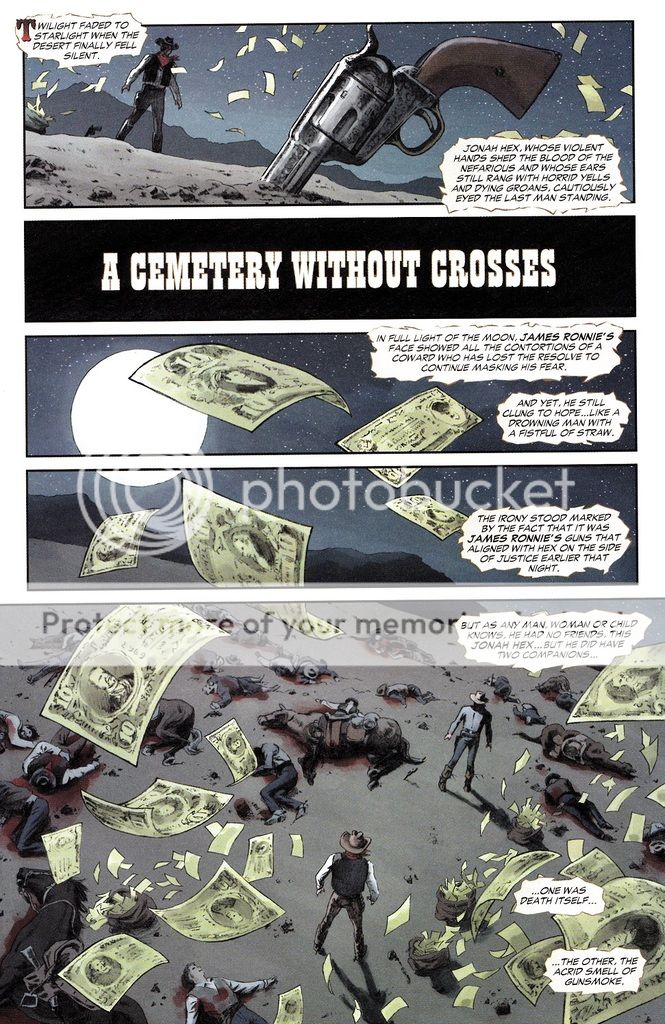
approach, the first being the inclusion of “title cards” throughout: though the credits page will name this story as “Giving the Devil His Due”, the first page presents us with a slim black panel bearing the words “A Cemetery Without
Crosses”, thereby giving the scene laid before us its own subtitle (a practice
that will carry on not only throughout this issue, but the entirety of the
series). The second difference is the
narration boxes: as noted earlier, these had replaced thought balloons starting
in the early 1990s, with Jonah first taking them on during his run at
Vertigo. However, the ones we see here do
not contain Jonah’s thoughts, but rather are the words of an unseen, unknown
narrator, hearkening back to the sort used in comics decades earlier, yet possessed
of a literary style more befitting the dime novels of Hex’s own timeframe. From here on out, the thoughts of our
favorite bounty hunter would be off-limits to us unless he chose to utter them
aloud, a decision that would serve to bring some mystery back to the character. Our narrator ain’t no slouch when it comes to
Hex lore, either, reminding us that “as any man, woman or child knows, he had
no friends, this Jonah Hex...but he did have two companions...one was Death
itself...the other, the acrid smell of gunsmoke,” and later remarks how Jonah
has been witness to “more than three decades of trials and unimaginable
suffering”, referencing not only how long he’d existed as a comic-book
character by that point, but also Michael Fleisher’s habit of setting virtually every story in 1875 (a trope that, happily, Palmiotti & Gray
would not perpetuate).
In truth, the beginning of JHv2#1 has nothing
to do with the main story, but between Jonah’s deadly actions and the
knowledgeable narration, those first four pages do serve as a mission statement
of sorts, letting new readers know right off the bat what sort of man Jonah Hex
is, what sort of world he lives in, and apologizing for none of it. A different sort of statement is made with
the plot of the main story, for it bore striking similarity to the Fleisher-penned JH#1 from 1977. As Gray
revealed, this was very intentional, “because the previous
incarnation of Jonah Hex under the Vertigo imprint was one we didn’t want the
book to be associated with. That’s nothing
against the Vertigo version or the version where Hex took on the [persona] of
Mad Max. At the time I remember we
wanted to send a clear message to readers that this was Jonah Hex as originally
envisioned so riffing on the very first issue seemed like a smart way of going
about it.”
In both cases, the basic spine of the story
involves the kidnapping of a wealthy man’s son, but with no ransom
demands. As in Fleisher’s tale, the
father is incapable of conducting a search of his own (in this newer case, the
father was crippled by an elephant during a hunting expedition -- “Seems fair,”
Jonah says when told the circumstances), and Hex is called in to follow a trail
that’s several weeks old. Then and now,
the trail leads him to a boy-fighting troupe, with this one being part of a
carnival, and the boys have to fight vicious dogs as opposed to each
other. Jonah steps in when their boss,
Victor Romanoff, begins beating the kids, and inquires whether they’ve seen the
missing boy. When they tell him no,
Jonah leaves, and two of the carnies --one of whom resembles Matheus Nachtergaele, an actor from Ross’s home
country of Brazil -- later try to ambush Jonah at his campsite. Jonah gets the drop on them instead and
forces them to ‘fess up, which leads to one of the biggest differences between
this tale and Fleisher’s: the missing boy is still alive, but he contracted
rabies from one of the dogs Romanov forced him to fight. A doctor in Romanov’s employ confirms that
the boy doesn’t have long to live, and that his final moments won’t be
pleasant, which leads to Jonah making a heart-wrenching decision:
Considering Jonah’s history of punishing anyone
who’d dare to harm a child, this mercy-killing must’ve been one of the hardest things he's ever had to do, and likely left a scar on his psyche as ugly
as the one on his face. To be sure, any
hatred he felt towards himself in that moment is soon turned directly against
Romanov: he strips the man naked, douses him in pig’s blood, and sets loose a
pair of dogs who proceed to rip Romanov to shreds off-camera (as before,
Jonah’s assessment of things is “Seems fair”).
Though Palmiotti & Gray wanted to distance themselves from the
Vertigo years, they managed to infuse just enough of Lansdale’s no-holds-barred
sensibilities into the traditional Albano/Fleisher story structure to create
something that honored both, as well as taking full advantage of the fact that
the Comics Code was all but dead by that point in history (DC finally dropped it from the handful of titles that still carried it in January 2011). They also brought to the forefront something
that was teased at over the years: Jonah’s feud with God. There’d been many a story under Fleisher’s
tenure that included a panel of Jonah addressing the Lord about one unfair
matter or another, but this first issue both opens and closes with the narrator commenting on Jonah’s views regarding God, Heaven, Hell, and the
bounty hunter’s place within it all. It
will be a subject that comes up multiple times over the next decade, but
surprisingly, it doesn’t come up at all in JHv2#2, which concerns a stolen
gold cross and a murdered priest (heck, it even begins on Dia De Los Santos Reyes). The most notable things in this
issue are a shot of the numerous scars on Jonah's body other than his face
(something alluded to over the past three decades, but no artist had bothered
to draw prior to the Palmiotti & Gray era), and a printing error on the
second-to-last page that flipped the art but not the placement of the word balloons.
JHv2#3 brings us a new landmark in Hex
history by virtue of its special guest star.
Previously, the only way to see Jonah pal around with other DC Western
folk was to wait for him to turn up alongside the Justice League or in some other non-Western title. But in this issue, Bat Lash became the first
established DC Western character to appear alongside Jonah Hex in his own
title...and just to make it more memorable, we also get to learn how they first
met! The two men cross paths when a
crooked sheriff and his pals nail Jonah inside a coffin and send him for a ride
over a waterfall (“Maybe he’ll wash up downriver and we can have him stuffed,”
one of them says, a sly wink to the Jonah
Hex Spectacular). Lash is witness to Jonah's peril and helps cut him loose from his bonds, telling the bounty
hunter about coming across a dying girl whose wagon train been ambushed by
white men impersonating Apache. When Hex
informs Lash that those same men are responsible for his trip over the falls,
they hatch a plan to bring them all down. The twist comes when Jonah hauls the sheriff
off to face Apache justice: the bounty hunter had been hired by the tribe to
prove they weren’t responsible for the wagon train raids. Lash is somewhat horrified by the sheriff’s
fate, but that doesn’t stop him from asking for a share of the reward, later
remarking that he could see the two of them “forming a certain kind of profitable friendship...” to which Hex
replies that he’s “not interested in
making new friends. I don’t even like the ones I have.”
“You’re kiddin’ me! You got friends?” Lash exclaims, putting a
humorous spin on the bounty hunter’s tagline.
In truth, Jonah had quite a few friends in the industry, including Didio
and Sales VP Bob Wayne (who, if you recall, did his own brief take on Jonah in 1990’s
Time Masters #3). According to Palmiotti, if it hadn’t been for
those two executives “we would have been off the book and character
after a year,” and that it “almost got cancelled about a dozen times.” Gray concurred, saying that he remembered “being
100% positive that it would be cancelled by issue 12. By that rationale with the book being single
stories we were trying to write every issue as if it were the last.” He also remembered Tony Moore -- the original
artist on The Walking Dead and a big
Hex fan in his own right -- told him at the time “not to fuck it up.”
As Gray pointed out, Jonah Hex relied on the old-school “one and done” formula, with the
majority of their tales getting wrapped up in a single issue, plus they would
sometimes skip forward or back along Jonah’s timeline, not concerning
themselves with setting each issue in a precise chronological order. It was sharp departure from the multi-issue,
continuity-tight storyarcs that the majority of other comics presented. Palmiotti explained, “A lot of that was the
idea that we couldn’t find an artist that would stick to a monthly schedule and
as well thought westerns were made for that kind of format, being that the
original series was done like that.”
Like the narration, it was a throwback to an earlier time, one that they
used to their advantage, according to Gray, who said, “Because we were writing stand-alone stories we
could have half a dozen issues working at the same time with half a dozen
artists. The joke was that Hex was the
easiest book to edit because we were almost completely left alone to do what we
wanted with who we wanted. I can’t
imagine that is something that will happen again. We felt very proprietary about Hex because we
were driving not only the content but also a lot of the appearance. We actively sought out people and could
influence the hiring of so many talented people with little or no interference.”
We’ll be talking about
those other talented people later, as we still have Luke Ross in the artist’s
chair for a few more issues. In
JHv2#4, the team introduces us to the newest recurring character in Jonah’s
life: Chako Jones, a young Mexican who damn-near talks Jonah’s ear off as the
bounty hunter brings him back to the town of Tall Pines. Chako is wanted for raping the mayor’s mute
daughter, Mayleen, but she soon reveals to Jonah (via a hastily-written note) that Chako is not responsible, so he springs Chako from the jail cell he’d just
helped to put him in...an action that leads both of them to an appointment at
the gallows. Chako is hanged first, and
seconds before Hex is to follow, Mayleen shows up with a rifle -- after firing
a warning shot, she uses it to write a message in the dirt: My father did it! Seems Chako had been witness to the crime,
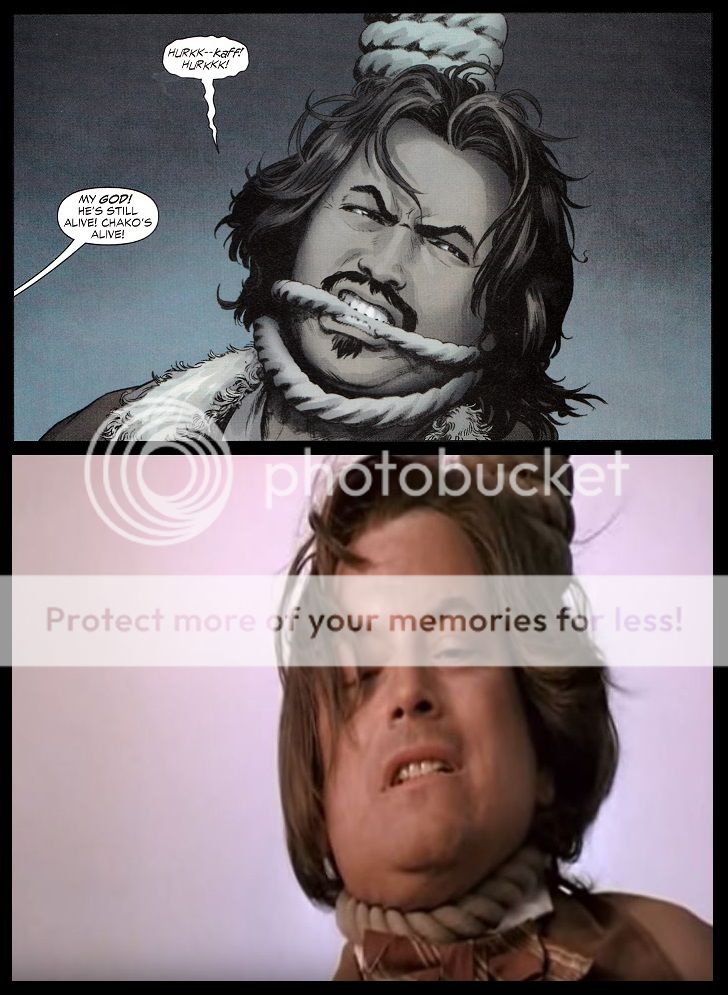
and the mayor was trying to get him killed before he could tell. Lucky for Chako, the noose didn’t cinch
tight. and they soon cut him loose (but not before we get a shot of him looking like Gary Sinise in The Quick and the Dead). Jonah leaves town right
afterward, glad to rid of the “little mosquito”, but it certainly won’t be the
last time he and Chako cross paths.
In the midst of Jonah’s
career revival, the modern-day DCU was going through Infinite Crisis, and while it didn’t affect the new series
directly (Jonah makes a blink-and-you-miss-it appearance in issue #6 as a resident of Earth-898), the event did resolve a gaping plot-hole in Jonah’s
history. Infinite Crisis Secret Files (April 2006) reveals how Superboy-Prime
kept accidentally changing the DCU whenever he punched the crystal barrier that
separated him from the rest of reality, and on one page, we can see both the Old West and 2050 versions of Jonah Hex reflected in two different
facets. Writer Marv Wolfman doesn’t give
us any specifics, but I’m inclined to believe “Superboy-Prime reality punch”
may be the closest to an official explanation as we’ll ever get regarding how
Jonah got home from the future (imagine the bounty hunter’s shock when he flipped from one reality to the next in the blink of an eye!).
JHv2#5 was another
landmark issue, not just for the story, but the artist: for the first time in
two decades, Tony DeZuniga was on hand to illustrate the character he’d
co-created. By this point in his life,
DeZuniga was retired from comics, and spent his days doing paintings which he’d
sell at his wife’s restaurant in California.
He still made appearances on the convention circuit, though, and
Palmiotti approached him at WonderCon prior to the title’s relaunch. “I went up to him and introduced myself and
said ‘I’m a huge fan of yours, and I’m actually writing with a buddy of mine a
new book,’” Palmiotti recalled during a chat we had in April 2006. “And he had sketches he was selling, and I
bought one of the sketches of Jonah Hex and said, ‘I’d love to get you to do an
issue or a cover.’ And he goes, ‘Oh, I
don’t have the time or the energy to do a book, but I’ll do a cover.’ And I called Wacker and gave him all of
Tony’s contact information, and all of the sudden...I guess Tony got a hold of
copies of the book, maybe. All of the
sudden, he wanted to do one.” So
Palmiotti & Gray wrote a story specifically for DeZuniga titled “Christmas
with the Outlaws”, Jonah’s first holiday-themed tale since HEX #18’s
“Thanksgiving”. Set on Christmas Day in
1870, Jonah has to defend an isolated train depot from both the outlaw gang
coming to rescue their buddy Mike Harley (whom Jonah captured), as well as from
another bunch of fellas out for revenge against Harley. DeZuniga’s figures were occasionally a little
more stout than they used to be, but overall he still delivered on his initial
“filthy and dirty” premise he’d come up with 34 years earlier, adding to it
some great atmospheric effects and the best close-ups of Jonah's ugly mug he’d
ever done in his career. Over the course
of the story, bullets fly, blood flows, and Harley does manage to get away, but
Jonah catches up with him ten years later to deliver a special Christmas gift:
a Gatling gun fired point blank in Harley’s face. It’s an ending unlike any ever seen in a Hex
comic before or since.
After that lovely image,
let’s take a breather and look at Justice League Unlimited #19 (May 2006), which serves as a sequel to Jonah’s
appearance in “The Once and Future Thing”.
This time around, Wonder Woman ends up in 1879 with Elongated Man (a
wink at JLA#198-199, perhaps?) and Vigilante (Greg Saunders), who join up with
Hex, Lash, and El Diablo to prevent Vig’s great-great-grandfather from being
killed by the Time Commander. The art by
Gordon Purcell and Bob Petrecca echoes the cartoon’s style perfectly, and as to
be expected for a kids-oriented book, writer Adam Beechen has his tongue
planted firmly in his cheek for most of the story, up to and including a moment
when Jonah does a straight-up parody of Clint Eastwood. There are some fine character moments for
Vigilante, however, and it should be noted that, while this comic isn’t
canonical, JLU#19 is the first time Vig and Hex are featured in the same story.
We’re back to Luke Ross
for JHv2#6, which delivers on the ever popular trope of "nuns with guns". On the trail of a murderous woman named Mary
Norton (who bears a striking resemblance to Oscar-Award-winner Linda Hunt),
Jonah arrives in the plague-ridden town of Salvation, where Mary -- now calling
herself Sister Agatha -- has convinced the townsfolk that she’s the only thing
saving them from both sickness and the Apache that keep raiding Salvation. To complicate matters more, one of the nuns
in her employ is an old acquaintance of Jonah’s: a young woman named Evelyn,
whom he hasn’t seen in seventeen years.
Though there’s no exact date given on this story, we can guesstimate
both when it takes place (1876) and when they last parted ways (1859) thanks to
a "One Year Later"-related throwaway gag inserted in the solicit for the issue. Their initial conversation
supports the numbers as well, for Jonah comments that Evelyn has “grown into a
handsome woman”, and she in turn asks how he got the scar on his face. This also means that, whatever shared
experience they had occurred during the same year that Jonah’s fiancée, Cassie
Wainwright, was killed. It’s a damn
shame we don’t get further into it, both because there’s barely any record of
that period in Jonah’s life and because what little is said in this issue
sounds so interesting (at one point, Evelyn quotes back to him: “If
self-preservation is an instinct you possess, I suggest you ride on and don’t stop until the past is behind you.” What in blazes happened to warrant Jonah saying
such a thing?).
Everything gets tossed
ass-over-teakettle moments after their reunion, as a soiled dove called Lilly
rats them out to “Sister Agatha”, who then orders the other nuns to burn Hex
and Evelyn at the stake for their “sins”.
Just has they’re lighting the fire, the Apache attack again, and Jonah manages
to free himself in the chaos.
Unfortunately, he’s not fast enough to keep Evelyn from getting terribly
burned, and the scene that follows is both beautiful and tragic:
Palmiotti gave Ross all
the credit for making that scene work, saying, “Luke caught the look in the
eye, and the horror, and the head going back, and you see it in Hex’s
face. The acting was brilliant.” Ross continued to deliver through the rest of
the story as Jonah goes on the warpath, killing anyone who stands in the way
between him and Mary/Agatha, although it’s Lilly who ends up shooting her
dead. The last page has Jonah carrying
Evelyn’s body to the cemetery and telling Lilly to get a doctor and meet him
there. When she asks if she should bring
shovels, Jonah answers, “No. You’ll be
digging with your nails.”
There’s even more carnage
in JHv2#7, so much so that it nearly spilled onto the cover: the original
solicits featured a grindhouse-caliber image that was soon switched out for a tamer one (both were done by Giuseppe Camuncoli & Lorenzo Ruggiero). It’s an unusual story in that Jonah’s
intended target keeps switching: first it’s a groom on his wedding day that
Jonah believes to be a wanted man, then it’s a man who shoots the groom in cold
blood for marrying the gal he was sweet on (by the by, the groom really was
innocent), and steals a high-quality rifle the bride gave her new husband as a
wedding gift. Jonah pursues the fella
for a week, only to see him cut down by nine skunks that took over the town
Jonah and his quarry had the misfortune of riding into...and to make matters
worse, there’s a wicked thunderstorm ripping open over their heads. Not giving a damn about anything else by this
point, Jonah tells the men surrounding him, “Give me the rifle an’ all a ya
live,” but they laugh him off. Lucky for
Jonah, a bolt of lightning hits an oil rig in the center of town, and the
bounty hunter starts cutting down skunks left and right. Unluckily, he runs out of bullets before he
can kill the leader, but don’t fret, ‘cause Jonah whips out a surprise from
inside his coat: a throwing-star in the shape of a sheriff's badge, the
signature weapon of lady gunfighter Cinnamon.
Did Jonah acquire that when they first crossed paths in JLA#198-199, or
is it perhaps a souvenir from a later encounter? Hard to say, but it’s a darn good thing he
had it on him. Too bad the bride ain’t
alive to hear all about it when Jonah arrives at her home, having chosen a
lethal dose of laudanum over living without her husband. Always true to his word, he leaves the rifle
beside her before departing.
Luke Ross also departs
with this issue (though he will supply the cover issue #12), and a few other
folks will come and go before we see the one who’ll become the title’s
“regular” artist. JHv2#8 is a bit on
oddity on the art front, with Dylan Teague drawing pages 1-13 and Val Semeiks
& Dan Green polishing off pages 14-22.
The differences in style and -- most especially -- the depiction of Hex make for a jarring experience. JHv2#9
more than makes up for it, though, starting with the gorgeous DeZuniga covered
rendered in black and white with a literal splash of blood-red. A great deal of this tale takes place in a
fever-dream, as Jonah -- who’s lost a copious amount of blood -- relives a
gunfight that took place four years earlier that inadvertently caused the death
of a little girl. DeZuniga’s art on this
takes on a wonderful hallucinatory quality, so that the reader has just as
hard a time distinguishing illusion from reality as Jonah’s having. Palmiotti & Gray don’t pull any punches
with the story, either, with Jonah later facing the wrath of the dead girl’s
mother and (in that twisted way you only get in Jonah Hex stories) making
amends. On a side-note, there’s a
tombstone in the background of one panel with the name “Patrick Wedge” on it,
the first of many shout-outs to actual Hex fans the writers snuck onto the pages
over the next decade.
Phil Noto -- who gave us
a great cover on issue #3 -- moves to the interior for JHv2#10 (and like
issue #7, this one also had a different cover shown in the solicits). As with Palmiotti & Gray’s first outing,
this issue shares similarities with another classic tale, specifically 1978’s
JH#12, wherein Jonah tussles with some swamp folk. In this case, Jonah goes into said swamp to
avenge the death of a black man whom no one else seems to care about. He soon finds the family responsible and
learns that the victim’s wife is still alive, but their baby was fed to the
gators (bad move!), and they immediately try to do the same to Jonah (even
worse move!). Unbeknownst to them, Jonah
survives the ordeal, then shows up on their doorstep to teach them a lesson...and
we should be glad that the majority of it happens behind closed doors.
David Michael Beck
illustrates his first Hex story in JHv2#11, and we also get our second
guest-star in the form of El Diablo, as well as our first bit of continuity for
the new title when the two of them cross paths with some of the carnies from
issue #1, who want to get even with Hex for killing their
boss, Victor Romanoff. This version of
El Diablo is slightly different from what we’re used to, as it forgoes the idea
of Lazarus Lane being a catatonic invalid during the day, and Wise Owl is
nowhere to be seen (we’ll presume this is due to the events of 1989’s Swamp Thing #85). For the first time, we actually get to see
Lane as himself, attempting to have a semblance of a life when El Diablo is
slumbering within him (to be sure, they are two separate entities, with the
demon only coming out when Lane is unconscious). We can also deduce that the story takes place
after JHv2#3, for Hex makes a passing reference to Bat Lash, and Lane asks,
“How is that scoundrel?” It’ll be
another year before we see the three of them together, so we’ll just move on to
the rest this story. The carnies try to
hang Jonah, but El Diablo rescues him, and the two men go out the next night to
extract vengeance, only to find some other fellas beat ‘em to it. Seems Romanoff was paying protection money to
the Pearson gang, and with him dead, they’ve decided to extract payment from
the freaks. El Diablo and Hex stop the
gang from killing all of them, but the demon then has to stop Jonah from
slaughtering the rest. “They have
suffered enough, Hex. To kill them would
be of no importance,” El Diablo tells him, then
points out that, by having previously killed Romanoff, he’s partially
responsible for the gang’s rampage.
Before Jonah rides off,
one of the carnies -- a tattooed woman who claims to have “the sight” -- says
he’s no different from herself or the other freaks, and that “Some day they’ll
put you on display and people will
pay money to stare at the dead body
of Jonah Hex. You’ll be a sideshow attraction!” to which the
bounty hunter simply replies, “If ya could truly
see the future...then why didn’t ya stop all this from happenin’?” The reader, of course, knows all this will
eventually come to pass...and if this story takes place after Jonah’s trip into
the future, he may know as well, presuming his memories of 2050 are intact post-Infinite Crisis.
While there’s no explicit
date on the story in Jonah Hex (vol.2) #12 (December 2006), it’s inferred by some of the dialogue that the event
depicted led to Jonah becoming a bounty hunter.
We’ve covered this ground before -- in 1979’s JH#30-31 and 1987’s Secret Origins #21 -- but I think we can easily integrate this new information in with the rest, placing it
after Jonah getting humiliated by veteran bounty hunter Arbee Stoneham. Jonah’s travelled all the way to Utah, only
to nearly freeze to death up in the mountains.
He’s soon rescued by a group of Mormon settlers who have problems of
their own. A local general store owner
named Dice not only refuses to sell them any supplies, he’s hired a group of
bounty hunters to kill every last Mormon up in the mountains. Noting both his uniform and large supply of
guns, the Mormons try to talk Hex into killing Dice, but he instead does his
best to act as intermediary, going to the general store and requesting simply
“Fifty pounds of beef an’ all the blankets ya have ta sell.” Dice knows exactly why Jonah’s there, and
proceeds to tell him about the Mountain Meadows Massacre, a real-life event
in 1857 that did nothing to help folks’ opinions about Mormons. The bounty hunters then show up and force Hex
to lead them to the settlement, only to find an ambush waiting for them -- most
of the bounty hunters are shot down by the settlers, and Jonah polishes one off
himself. Once the fight is over, Jonah
confronts the Mormon leader about his actions, both on that day and in
1857. The man points out that what he
did -- though he’s not proud of it -- isn’t much different than what Jonah himself
did during the War. The man’s words must’ve
struck a chord with Jonah, for this time he does strike up a deal with the
settlers, then pays Dice one last visit, a scene rendered in fine detail by
Paul Gulacy:
It appears the events of
this new story were the last push Jonah needed to fully take on the role of
bounty hunter. With the incident in
SO#21, he collects a bounty by sheer dumb luck, and in JH#30-31, he’s first
pressured into participating by the law, then he does it voluntarily in the
hope of saving his friend (which he fails to do). JHv2#12 would be the first time he truly
takes on a bounty for pure financial gain, with the added incentive of knowing
that he’s protecting innocent women and children (something that’ll influence
his decisions for many years to come).
Had the series ended there as Justin Gray feared it might, this would’ve
been a fine capper to the run.
Thankfully, he and Jimmy Palmiotti were allowed to go on bringing us new
adventures every month, and as they moved into their second year, the writing
duo expanded their scope, delivering longer stories and more insights into
Jonah’s past, along with (dare we say it?) finding the ornery ol’ cuss a
soulmate. ERRATA: The same day I posted Appendix B, I was alerted by my friend and Matching Dragoons blogger Dwayne Hendrickson that I totally omitted Jonah's adoptive Apache family. I corrected the oversight a couple of days later.